Showing posts with label American History. Show all posts

Saturday, June 20, 2026

The Gods of New York, by Jonathan Mahler


A witty, fast paced roller-coaster ride through 1980s New York.

New York in the 1970s was a city in debt and seemingly terminal decline. Its manufacturing base had been eviscerated. Poverty was endemic and crime at an all time high. New York needed money. Then came the 1980s, and Reaganomics and deregulation. Boom! The town was back in business. It pivoted from old school industry to computerised finance. Digitising stocks and money put them on steroids. People became extremely wealthy.

Gods of New York covers four years at the end of the 80s: 1986-1989. Mayor Ed Koch sought and won an historic third term. But there was much strife afflicting the city - racially motivated violence, the AIDS crisis, high level corruption, poverty, homelessness, drug addiction and the mentally unwell living on the streets. For every societal ill there was a charismatic if controversial advocate. The list of such characters is mesmerising: Black activist Reverend Al Sharpton, AIDS crisis agitator Larry Kramer, film maker Spike Lee, disease specialist Anthony Fauci and crime fighting lawyer Rudy Giuliani, to name a few. There are also plenty of less famous characters, such as Joyce Brown, a homeless woman turned celebrity. The city had tried to have her institutionalised, but she fought through the courts to be allowed to return to the street.

Hovering above the city is Donald Trump, a glittering success and a figure of undisputed economic prowess. Throughout the late 80s Trump would back himself into a corner by over investing in the Atlantic City casino scene, just at a time when punters had no money and were pulling in their spending. And yet the banks continued to lend him staggering amounts of money. His debts became so eye-watering that the banks essentially couldn’t let him fail.

Author and journalist Jonathan Mahler does a brilliant job of building a compelling narrative around the events, scandals and crimes of the day. (A lot of time is devoted to harrowing crime cases.) He has a witty style and clever turn of phrase, able to distill the cultural and economic movements of the time into pithy one liners. The picture that emerges of New York is of a place that is terribly fractured and extreme. A city of dreadful poverty, entrenched racism, drug addiction, homelessness and mental illness. Why, one wonders, so many problems in a city that is an economic engine room of the world economy? The book doesn’t end on a cheery note, with Jonathan Mahler asserting that these divisions, between rich and poor, black and white, have only become more entrenched.  

An entertaining and insightful portrait of a complex city. New York may be cruel and unforgiving, but it produces extraordinary people and cultural movements. 

The Gods of New York, by Jonathan Mahler. Published by Hutchinson Heinemann. $36.99

NOV25

Thursday, March 6, 2025

Lucky Loser: How Donald Trump Squandered his Fortune and Created the Illusion of Success, by Russ Buettner & Susanne Craig

Two award winning journalists follow Trump's topsy-turvy money trail. 

Russ Buettner and Susanne Craig are journalists at The New York Times. Since 2016, when Trump came to power, they have been closely investigating the former president’s finances. Both journalists won a Pulitzer Prize for their work on Trump’s income tax returns which were anonymously mailed to Susanne Craig. Lucky Loser is the result of their years of reporting, plus additional new interview material. 

There were perhaps two pivotal people that helped create Trump. Firstly and most importantly, his father Fred Trump, a property developer that used depression era government programs to access attractive financing deals. A lack of government oversight allowed Fred Trump to skim off extra profits by inflating building costs. Fred became a multi-millionaire. When his go-getter son wanted to enter the family business, Fred overlooked many of Donald’s faults, such as his impetuousness and failure to perform due diligence. Trump junior would rack up reckless debts, leaving a financial mess in his wake, only to have his father come in and mop things up. The mystery is why Fred, a mild mannered man who avoided the limelight, enabled his blowhard son, often referring to him as “the smartest person I know”. 

The second person instrumental in giving the world Donald Trump was British television producer, Mark Burnett, creator of 
The Apprentice. At a time when Trump's finances were in more disarray than usual, the flashy, media hungry businessman was seen as a logical host for the game show. Trump had a reputation among media insiders at the time, and some saw him as a bit of a joke. The show’s producers were shocked when they were shown the Trump Organisation offices at Trump Tower, where filming was to begin. The offices had an overpowering smell of mold, from the carpets, and a lot of the wooden furniture was chipped and in need of repair. It was soon obvious that a set would need to be built. There was spare office space on another floor, which would become home to The Apprentice. Trump had a habit of firing contestants that were good performers on the show, so the editors would have to go back and re-edit to make them look less competent and more worthy of being kicked off the show. In large part it was the show’s editors that made Trump look good.

There were many other enablers along the way, most notably financial journalists who should have called out Trump’s boasts and falsehoods much earlier. But Trump got free pass after free pass, until the illusion of Trump’s success became so big that no amount of truth telling could kill the lies. Even Bill and Hillary Clinton attended Trump’s marriage to Melania. Is it any wonder that so many Americans came to believe Trump really was their political saviour? 
Lucky Loser also shows consistent behavioural patterns - a recurring victim mentality, a penchant for impulsive decision making, a delusional self-belief - that highlights a character that has not changed one bit over the decades.   

An exhaustively researched book that will last as a damning document.

Lucky Loser: How Donald Trump Squandered his Fortune and Created the Illusion of Success, by Russ Buettner & Susanne Craig. Published by Jonathan Cape. $36.99

OCT 24

Wednesday, February 8, 2023

The Wrath to Come, by Sarah Churchwell


Academic Sarah Churchwell demonstrates that the American Civil War never really ended.


American academic Sarah Churchwell has taken the interesting route of trying to explain Donald Trump's dominance of US politics by examining the text of Margaret Mitchell's Gone With The Wind. UK based, Churchwell is a professor at the University of London, perhaps giving her enough distance to form a clearer view of American culture, history and racial issues. After being asked so many times why the American people had chosen Trump, she wrote The Wrath to Come in response. Her argument can be put in Shakespearean terms: the past is prologue. The American Civil War never really did solve issues of race, slavery and the South's financial dependence on cheap Black labour.

In reviewing both the novel and the famous film adaptation, Churchwell finds a narrative of white victimhood and self-pity. Slavery was not that bad, the majority of whites believed, and it was only the Northern incursion into the South that brought problems. Everything was fine before then. Slaves were mostly satisfied with their lot, whites believed. Hence the utter shock when the enslaved were set free: their white oppressors couldn't believe they wanted to leave. What makes this denial even more extraordinary is the public nature of lynchings. Thousands turned up to watch these grotesque spectacles that involved mutilation and dismemberment before death, then the scrambling for body parts as souvenirs afterwards. How could whites not realise that Black people would be rightly terrified? And yet Southern white people continued to paint a picture of themselves as a civilised and gracious community.

The Wrath to Come (the title is a quote from James Baldwin, a euphemism for white rage) interweaves history with literary criticism. Churchwell contrasts Gone With the Wind's' timeline against the actual historical record, throwing into relief the text's underlying racism and wilful ignorance.

A difficult and disturbing read that does make sense of today's American white supremacism. It also provides a template of white denialism that could be transplanted to many countries around the world, Australia included.

​The Wrath to Come, by Sarah Churchwell. Published by Apollo. $39.99

Review by Chris Saliba

DEC22

Wednesday, October 20, 2021

The Dead are Arising: The Life of Malcolm X, by Les Payne and Tamara Payne


From street hustler and jailbird to powerful Black leader, the story of Malcolm X has a lot to teach about race in America.


Born in 1925 in Omaha, Nebraska, Malcolm Little grew up rough. His mother, while pregnant with the future leader, would find herself harassed by the Ku Klux Klan, knocking on her door one night searching for her husband. It was an era where lynchings were almost routine and segregation was law. Malcolm's parents Earl and Louise were both supporters of the activist, Marcus Garvey, who promoted Black separatism and Pan Africanism. Earl Little would die relatively young, run over by a tram car, and Malcolm would forever maintain he was murdered by white supremacists. Louise Little, left without a husband and seven children to look after, couldn't cope and was institutionalised. Malcolm grew up hustling on the streets, got involved in petty crime and ended up in prison.

In prison, Malcolm became a voracious reader and autodidact. At this time his brothers introduced him to the Nation of Islam (NOI), nominally a Muslim organisation, but in reality a Black nationalist group that espoused Black separtism. With a changed name Malcolm was soon a prominent and charismatic leader, a much sought after speaker and interview subject. Despite this success, the contradictions of Nation of Islam chipped away at his conscience, especially its separatist stance. In 1961, Malcolm attended a secret meeting with members of the Ku Klux Klan. The two groups believed in keeping the races separate, a key point they agreed on, although for different reasons. The contradictions came brutally to the fore when the KKK members wanted information on Dr. Martin Luther King, so they could assassinate him. King being an integrationist made him an anathema to both parties. Malcolm X withdrew from the meeting, deeply shaken. It remained harder and harder to maintain ideological purity, faced with so many wild contradictions.

Malcolm X would leave Nation of Islam when it was proven without a doubt that its leader, Elijah Muhammad, was a fraud and hypocrite, siring half a dozen children with different women and using his position to accumulate obscene levels of wealth. The break with NOI would make Malcolm an enemy and target for assassination, from his own people.

Journalist Les Payne has conducted hundreds of interviews with friends, relatives and colleagues of Malcolm X, giving an extraordinarily well researched portrait of a complex, evolving figure. Against the background of a racist America, with white supremacist terror groups making daily life a nightmare for African-Americans, it is easy to see the appeal of a philosophically bankrupt group like NOI. What makes Malcolm X such a compelling character is how a man with little education and fewer prospects could transform himself into a thought provoking leader on the question of race, but also one who was willing to admit when he had got it wrong. He could remake himself. Unfortunately, that remaking resulted in his death, helped along by police and spy agencies turning a blind eye and not marshaling enough resources for his protection.

The Dead Are Arising helps explain so much, particularly to a white or non-American audience. The harrowing, detailed descriptions of the lynchings of Black men are a horror to read. The blood is soaked on the pages. Les Payne doesn't hold back on illustrating the many contradictions of Black politics and race – the prejudice within the community against darker skin, the bizarre fact that NOI was started by a white man named Wallace D. Fard, a convicted felon who posed as mixed race and mysteriously disappeared in 1934. 

An elegantly written book, one that strives for truth and moral clarity. 

The Dead are Arising: The Life of Malcolm X, by Les Payne and Tamara Payne. Published by Vintage. $65

Tuesday, October 15, 2019

The Library Book, by Susan Orlean

Susan Orlean examines every aspect of the library in this entertaining and humane book.

On April 29, 1986, a terrible fire broke out at the Los Angeles Public Library. It caused great devastation. Some 400,000 books were destroyed; another 700,000 experienced smoke or water damage. It took the fire department seven hours to put out the flames. The rebuilding took years and cost millions of dollars.

Journalist and writer Susan Orlean stumbled across these facts only recently, amazed that the fire wasn’t better known. A reason could be that the Chernobyl nuclear plant disaster occurred a few days before the library fire, eclipsing it in newsworthiness.

How did the fire start? To this day it remains a mystery. The prime suspect was an attractive young man, Harry Peak, a fantasist and compulsive liar who dreamed of being an actor. He was seen at the library on the day of the fire, and he even told friends he had lit it, but then chopped and changed his story so much it was impossible to know what to believe. He was imprisoned for three days, but then the charges were dropped as it was felt the case against him wouldn’t stand up in court.

The eccentric Harry Peak is just one character among many in this multi-faceted, kaleidoscope-like book that looks at the history, development and workings of the Los Angeles Library. Orlean also chronicles the broader story of the library, from its early American pioneers (there were many eccentrics and true originals in this class) to today, where the library incorporates the latest in technology and sometimes struggles to remain an institution that is open to all, including the city’s many homeless seeking warmth and comfort.

The Library Book is a deeply satisfying book, explaining in entertaining language every aspect of how a big, modern library works. It’s also a story with heart and soul, the library being a vital and humane place, somewhere to find refuge from a world of ceaseless troubles. It’s also a book that pays due homage to the work of the librarians, those precursors to the Google search engine, ever ready to answer questions.

The Library Book, by Susan Orlean. Atlantic $29.99

Tuesday, March 18, 2014

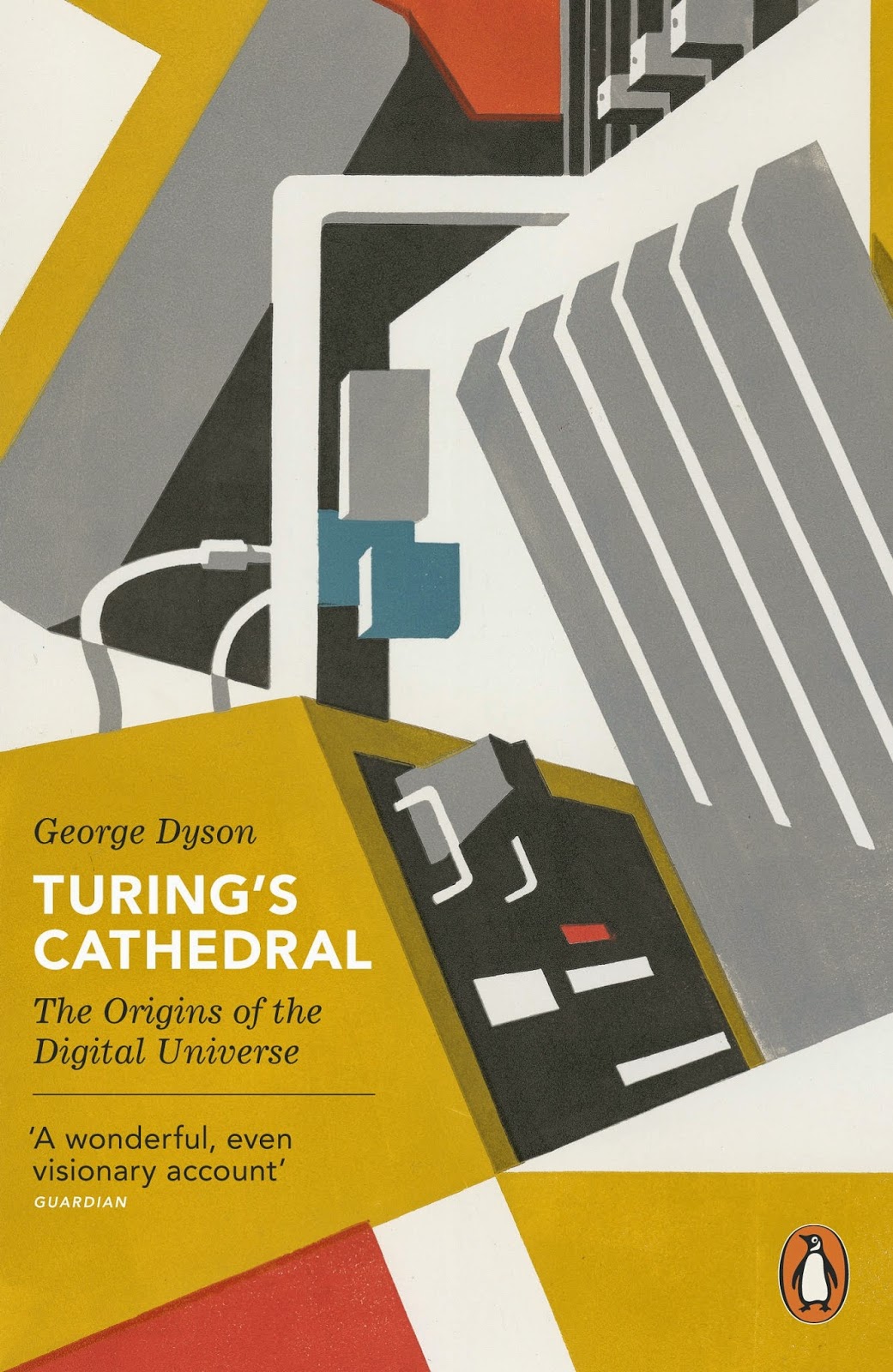
Turing's Cathedral, by George Dyson

Staff Review by Chris Saliba

George Dyson's history of the computer covers the key mathematicians and scientists whose genius brought this extraordinary machine to the world, and has much background information on how it was the US military who commissioned it.

This ‘history of the computer’ by George Dyson concentrates on the group of scientists (and the vibrant interchange of their ideas) that led to the first digital computer. Most of the book’s narrative centres around the Institute for Advanced Study (IAS) at Princeton, New Jersey, where this group of gifted mathematicians and scientists worked. Mostly Turing’s Cathedral is the story not of the British mathematician Alan Turing, but John von Neumann, the Hungarian-American mathematician and physicist.

The first electronic computer, the Electronic Numerical Integrator And Computer (ENIAC), was created in 1946. It was financed by the US Army and its purpose was to calculate artillery firing tables for the United States Army’s Ballistic Research Laboratory. When a bomb exploded, every bit of its trajectory had to be mapped to try and make it as effective and controlled as possible. The reason the army needed to commission such a computer was the exceedingly long time taken to do these computations manually. The army had a lot of data to process. To cut a long story short, the ENIAC was needed as a matter of urgency in the advancing of nuclear war technology. As noted in Eric Schlosser’s excellent Command and Control, the internet and computer systems we enjoy today are a direct legacy of the cold war, with its need for powerful computing capacity.

Two quotes from the book encapsulate this perfectly:

"'It is an irony of fate,' observes Francoise Ulam, 'that much of the high-tech world we live in today, the conquest of space, the extraordinary advances in biology and medicine, were spurred on by one man's monomania and the need to develop electronic computers to calculate whether an H-bomb could be built or not'". 

'First-generations electronic computers fostered first-generation nuclear weapons, and next-generation computers fostered next-generation nuclear weapons, a cycle that culminated in the Internet, the microprocessor, and the multiple-warhead ICBM.'

This central figure of John von Neumann is an interesting one in this light. He was very much what you’d describe today as a ‘hawk’ in political terms, and an advocate of preventive nuclear war. He was drawn to the military and appears to have been pretty much an emotional blank.

While this book contains much fascinating material, I found it a bit of a hard slog. I very much wanted to enjoy it more, but struggled to concentrate, especially near the end. The two main problems are that its organisation is a bit of a shambles. It flits all over the place and is hard to piece together as a narrative. Secondly, a lot of the technical detail is next to impossible to follow, especially if you’re like me, with no aptitude for mathematics. Some of the sentences I had absolutely no hope of deciphering without finishing a degree in computer science. If you’re a boffin in this area, you’ll no doubt find it much easier (and probably more interesting). But for the common reader, it throws up a barrier of complexity.

That’s a shame, because the story of the electronic computer and its military origins is a fascinating one. Despite these caveats, there is much that I did learn from the book, and it has whetted my appetite to read further and fill in the missing gaps of my knowledge.

Turing's Cathedral: The Origins of the Digital Universe, by George Dyson. Published by Penguin. ISBN: 9780141015903  RRP: $22.99

Friday, January 24, 2014

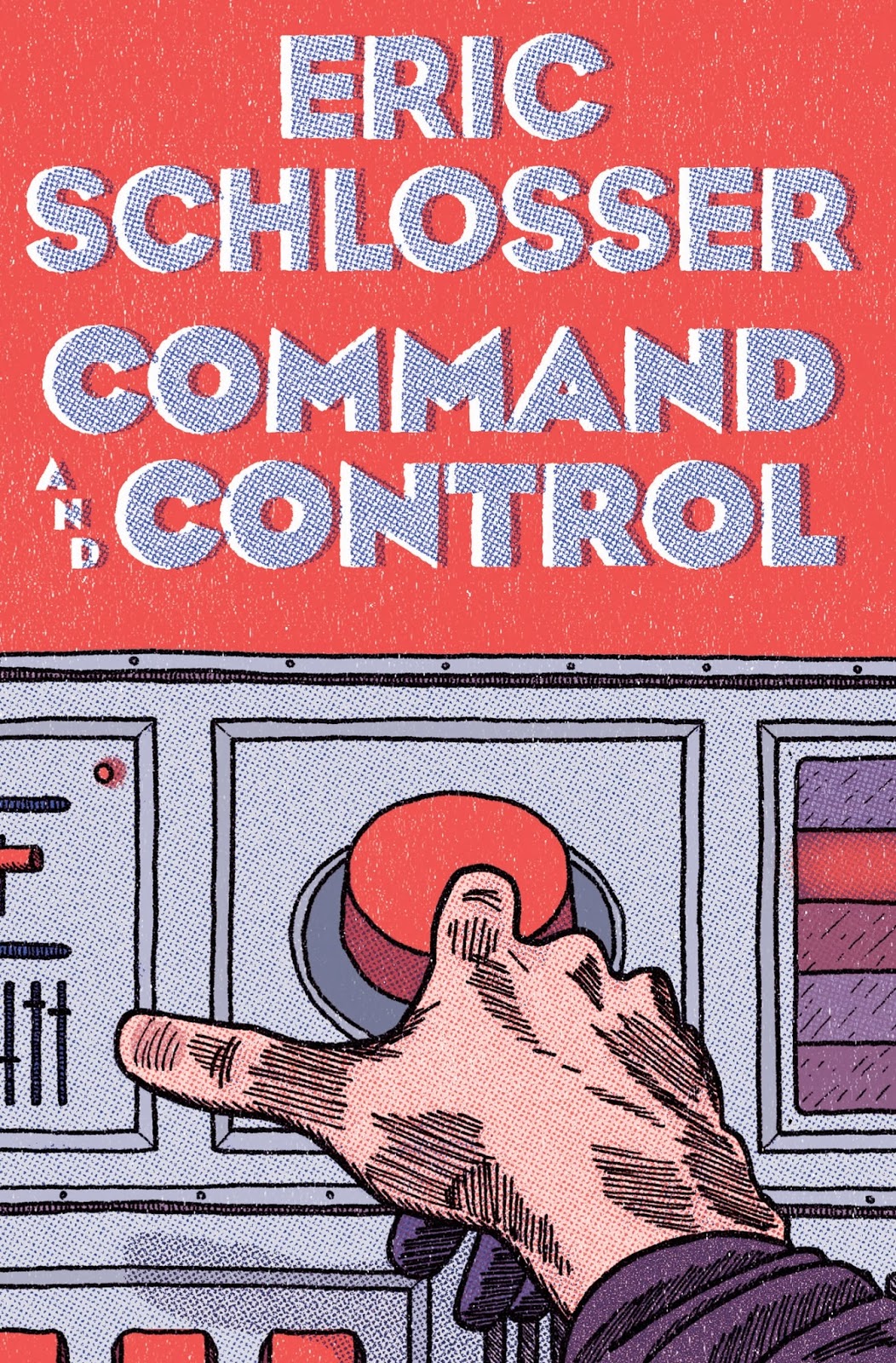
Command and Control, by Eric Schlosser

Staff Review by Chris Saliba

American journalist Eric Schlosser revisits a 1980 nuclear missile accident, weaving around this gripping narrative a fascinating and frightening 70 year history of the US's nuclear arsenal. The result is a must read, providing a new angle on the cold war from the people who were there working at the ground level. 

Eric Schlosser is well known to readers for his 2001 book Fast Food Nation, which, amongst other things, investigated industrial food production, especially the hazardous work practices of modern abattoirs. Command and Control continues this theme of work place safety, but on a much, much larger scale. The book works as a dual history of nuclear accidents and the Cold War, brilliantly interweaving the two: the practical and the theoretical. It also raises many profound and critical questions about technology and how much control we have over it. This is one of those books that will genuinely scare you.

Command and Control's main set piece is the 1980 Titan II missile accident that occurred in Damascus, Arkansas. Schlosser has interviewed the surviving participants of that explosion, giving his retelling of events an edge-of-your-seat urgency. Every so often the narrative shifts, and we are taken back to the history of nuclear weapons, a history that is necessarily a heavily political one. It’s to Schlosser’s credit that he so skilfully interweaves these two narratives into a cohesive whole, allowing the reader to see how individuals are caught up in history's sweep.

The Damascus accident that the book concentrates on highlights just how complex, and hence fragile, nuclear technology is. Two fuel technicians were doing some routine work on a Titan II intercontinental ballistic missile that was housed in an underground silo. The Titan II also carried a nuclear warhead. One of the technicians accidently dropped a socket down the silo, which ripped a hole in the skin of the missile. Fuel started leaking, control panels that were supposed to give accurate reading for what was happening in the silo didn’t function properly, and soon enough the missile was threatening to explode. One man eventually died and some 20 others were injured.

The nuclear political narrative that is interspersed with this story is equally mind blowing, both from a psychological and technological point of view. At first, when America dropped atomic bombs on Japan, causing a great human tragedy for that country and also ending the Second World War, Americans were proud of their technical know-how and ability. That feeling soon came to an end when Americans realised that the same could now happen to them. The arms race was on, but politicians could not think their way out of the problem.

To read the various strategies for launching a nuclear war, and the magic thinking necessary to fool military strategists into believing that it could be done ‘rationally’, with casualties minimised, can only be described as a form of abnormal psychology. Planners and strategists tried desperately to think their way out of the total war conundrum that nuclear war technology determined, but couldn't. Reading these sections of the book is like watching someone stuck in a terrible dream, running to try and escape but with legs hopelessly unresponsive. 

Nuclear war messed up everyone’s thinking. Trying to create a logical nuclear defense policy starts off hopefully, but the end game is always the same: total annihilation. Rational war planners couldn't accept this outcome, but then found themselves developing policies that would have resulted in virtual national suicide. The list of pacifists and politicians who found nuclear war abhorrent, but who nonetheless eventually signed up for all out nuclear war, is astonishing. Even Bertrand Russell, the First World War pacifist who went to jail for his views, advocated bombing the Soviet Union back to the stone age. Incredible! In the end, the US settled for an all out nuclear war policy, one that would, on conservative estimates, kill at least 54% of the Soviet population if unleashed. This policy was in place from 1960 to 2003 - that is, official policy! (It was called the Single Integrated Operational Plan, or SIOP.)

Different readers will draw different conclusions from Command and Control. What I found most fascinating is how technologies contain their own rationales and are wholly deterministic. Once nuclear bombs had been invented, it was impossible to go back. Nuclear power controlled humans, not the other way around. Nuclear power also unleased a huge amount of fear, distrust and secrecy. The amount of secret information that was even withheld from successive Presidents is extraordinary. The public were constantly misled or lied to about the danger of their own country’s nuclear arsenal.

Another interesting aspect of the book is how unbelievably complex the technology is for nuclear war heads. It’s astonishing how many serious malfunctions occurred. For example, computers processing information from missile sensors would falsely signal an all out Soviet attack was happening. When computer experts finally investigated what the problem was they found a 40 cent computer chip was faulty! But here’s the good news. The need for intergrated systems and complex data analysis meant the need for computer networks. Information had to be communicated computer to computer, and super quick: you got it, the internet.

This book completely spun me out, and in a funny way, answered a lot of questions about the mad technological world we now live in. Highly recommended!

Command and Control, by Eric Schlosser. Published by Allen Lane. ISBN:  9781846141492  RRP: $29.99

Saturday, July 13, 2013

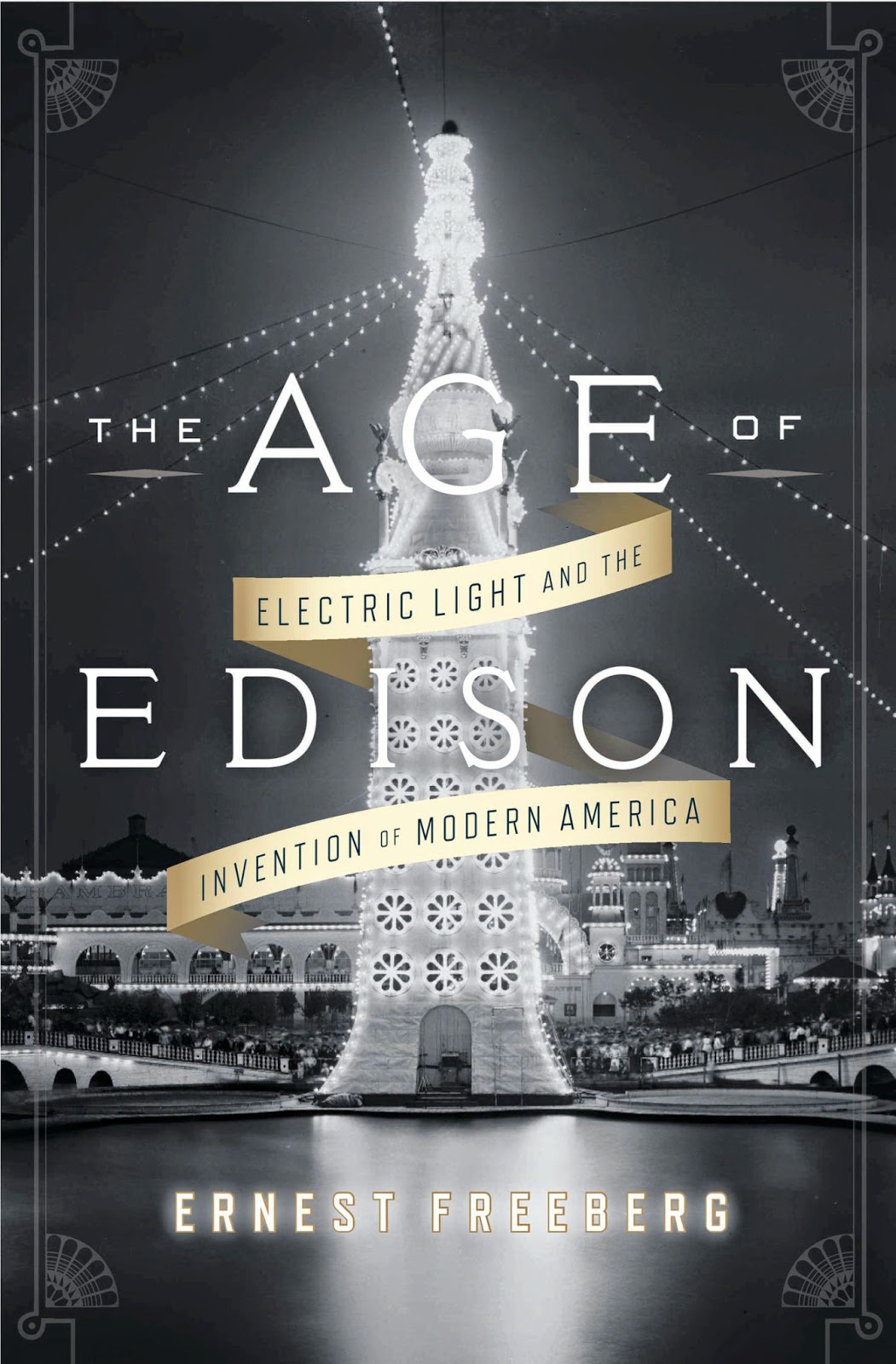
The Age of Edison, by Ernest Freeberg

Staff Review by Chris Saliba

The Age of Edison is a splendid book. It transports the reader back to a time when society was being turned upside down with the introduction of a seemingly magical new technology: the incandescent light bulb. Gas was on the way out, but electricity’s road to dominance was not a smooth one.

The title of this book makes it sound like a paean to the achievements of Thomas Edison, but The Age of Edison is really a cultural-scientific history of electricity’s early years from the late 1870s to the 1920s. While it was Edison who invented the incandescent light bulb, there were many inventors and scientists who came before him. There would be many innovators who would succeed him.

For most of us, children of the late 20th century, it’s impossible to imagine a time without lights that could be turned on with the flick of a switch. My grandmother, born in the 1920s and growing up in the Melbourne working class suburb of Abbotsford, tells me she remembers when electricity was first connected to residential houses. Apparently residents received booklets advising that electricity was safe and nothing to worry about. Reading The Age of Edison plunges you back into the era of gas lighting and all its imperfections, at a time when America was on the cusp of going electric. Edison unveiled his light bulb at his Merlo Park laboratory in 1879. From that time on, incandescent lighting went on its inexorable rise. There were plenty of fits and starts as things went wrong and the technology, often dangerous and disruptive, found its way into the culture.

Gas, Soot and Live Wires

The era of the gas lamp was not a pretty one. Gas lamps produced a lot of soot, smelt none too good and consumed a lot of oxygen. Gas lamps in the home over time ruined the furniture, the drapes and the walls. Nor was the quality of the lighting good. In theatres that were lit with gas, crowds were almost asphyxiated by the fumes. Electric lighting promised clean, bright light.

However, there were problems. The wiring, for a start, was extremely hazardous in the early years of electricity. Loose, live wires often hung from electricity poles and there were many deaths. Citizen groups even agitated for the removal of the hated poles. At one stage there were strong calls to bury all the wiring underground, but this was found to be next to impossible to do. The future of electricity at this stage was not a certain thing, and gas companies developed a smug attitude, sure that electricity was nothing more than a passing fad. Reading about the many tragic deaths of linesmen, innocent citizens and poor animals due to loose wires and other tragic accidents, it makes you realise how much earlier generations sacrificed so the technology could be developed to a standard we all enjoy today.

The Age of Edison is a splendid book. It’s a well-considered history of the early age of electricity, looked at from all social, economic and scientific angles. Electricity is something we all now take completely for granted, but author Ernest Freeberg highlights many things we never think about. For example, surgery before electrical lighting was a nightmare. Bodies cut open for invasive surgery needed excellent lighting so surgeons could work with accuracy. Before incandescent lighting, this was not possible, with operations performed under skylights at advantageous times of the day.

The economic effects of incandescent lighting are also now taken for granted, but back in the late 19th century, being able to extend the working day into the night provided a virtual revolution in productivity. Think what the economy would look like if all work stopped at sun set. Even in the home, where once the family members huddled around a single gas lamp to read or sew, could now work independently at their own electric lamps. The Age of Edison shows how society was completely revolutionised, how everyone’s lives were changed forever, by the invention of incandescent lighting. The brilliance (pun intended) of Freeberg’s book is that he takes you through a society undergoing enormous change at the turn of the century, and makes you feel what it must have been like to experience such change. Freeberg also shows how electricity has made us the people we are today, by tracing the history of a technology we now take as a normal part of life.

The Age of Edison, by Ernest Freeberg. Published by Penguin Press. ISBN: 9781594204265 RRP: $29.99

Tuesday, March 10, 2009

Team of Rivals, by Doris Kearns Goodwin

The cover blurb on this 2009 re-issue of Doris Kearns Goodwin’s Team Of Rivals (first published in 2005), raves that this is the ‘book that inspired Barack Obama’. That was enough for me to want to read this hefty tome on ‘The political genius of Abraham Lincoln’.

I know next to nothing about Abraham Lincoln and the American Civil War, so Team Of Rivals provided a bit of a crash course. I’m glad I started my course on the American Civil War with this book.

The great thing about Goodwin’s biography / history of Lincoln and all the other major players of his administration, including the influential women that provided counsel and advice to these men, is that it is so vividly brought to life. The author effortlessly weaves so many quotes into her narrative, and finely paints in so many small, day-to-day details, that you feel like you are physically there at all the important events described. This makes every page of this 750 page history compelling reading.

As for the character of Lincoln, he is almost like a ‘grown up’, trying to temper the vanities, ambitions and human foibles of the men who composed his cabinet into a working political machine. His political genius was not to harbour any grudges, and to be of a magnanimous character. The more you read of him in this book, the more and more you come to deeply respect this extraordinary figure.

The lesson Lincoln teaches is that everything is not always about you, and that you must put your vanity to one side, as there are human and historical events that are of more importance than your own ambitions.

I also liked how he said you must be patient, and wait for the times to be propitious. Lincoln never attempted anything without first having public sympathy on side.

The last chapter of the book, which details Lincoln’s last weeks before his assassination were absolutely riveting. I never knew a triple assassination was planned for the Secretary of State and Vice President as well.

The epilogue details what happened to the other major characters. I audibly gasped when I came to the last page, and discovered that poor Mrs Lincoln, after suffering so much grief at the loss of her son Willie, and then her husband, had to deal with losing another son, Tad, at the age of eighteen. It seemed incomprehensible to me that fate could be so cruel. Mary Lincoln virtually went mad in her final days, and ended her life a virtual recluse.

Thursday, August 26, 2004

Henry Ford and the Jews, by Neil Baldwin

Henry Ford's such a twit, you have to conclude that his success was a complete fluke. He was still a loser in his late thirties, and didn't hit upon the winning formula of factory line cars produced cheaply until his early forties. He then made a shit load of money, became very powerful, became bored, and turned to anti-semitism.


Henry Ford even looks like a freak - he reminds me of Dr Smith out of Lost in Space.


To assauge his bordem he set up the Dearborn Independent, and quickly turned it into an organ of anti-semitic bile. He collected the anti-semitic articles into a series of books.


Hitler was a huge fan and awarded him a medal. Regrettably, Ford's anti-semitic output was used as inspirational material for the Nazis.


As I said, Henry Ford comes across as a big loser. Didn't he have anything more constructive to do with his time? That's why I say his success was a one off fluke - otherwise he is an entirely unimpressive character.


After reading another book on anti-semitism you have to conclude it's a very childlike prejudice (I learnt that prejudice actually means premature judgement). These fanatics seem like children who believe in the bogey man. And they do believe.


Best book on this subject is Hitler's Willing Executioners. I forget the author's name, but I found it unputdownable (is that a real word?).

Wednesday, August 11, 2004

The Sorrows of Empire, by Chalmers Johnson

I always thought John Pilger was indulging in a bit of hyperbole when he said the United States was the world's biggest exporter of terrorism. Having read the Sorrows of Empire, I now totally agree.

Chalmers Johnson is a former cold warrior. He supported the Vietnam war and thought the hippies and students opposing it didn't know what they were on about. In his last book, Blowback, he says he wish he'd been more open minded to what these critics were saying.

Mr Johnson has followed up the prescient Blowback, which he wrote before the September 11 attacks, with an awesome indictment of the United States and its non stop military culture. He makes the distinction between being prepared for war, an army trained to fight wars, and militarism, a constant military culture.

I haven't read a book that explains so well the US military presence that straddles the globe. There are some 725 listed military bases the world over - many more remain secret. Soldiers serving on these bases are exempted from the laws of the host country, under agreements made with the United States. Thus, many crimes committed by these soldiers on foreign army bases - murder, rape, criminal negligence resulting in civilian deaths - pretty much go unpunished. Anyone who has studied the My Lai massacre, and knows how the ringleader got off pretty much scott free, will know what I'm talking about.

This is one of the many reasons for anti-American sentiment in foreign countries. When two soldiers raped a twelve year old girl on the Japanese island of Okinawa - a US military base since the second world war - thousands turned out to protest.

The book brilliantly details the frightening amount of power the Pentagon wields. The money spent - and lost, or rather wasted - is staggering:

'This "circulation of elites" tends to undercut attempts at congressional oversight of either the Defense Department or defense contractors. The result is an almost total loss of accountability for public money spent on military projects of any sort. As Insight magazine journalist Kelly O'Meara has noted, in May 2001 the deputy inspector general at the Pentagon "admitted that $4.4 trillion in adjustments to the Pentagon's books had to be cooked to compile ...required financial statements and that $1.1 trillion.....was simply gone and no one can be sure of when, where or to whom the money went."'

I need not say where the money could have been better spent. Instead, the US spends loads of cash in training armies in other countries. Only recently I read that the US is looking at spending $700 million on training 'friendly' militias in foreign countries. That's what can be understood as exporting terror.

There is a good chapter on globalization too. He quotes Lawrence Summers, who was the chief economist at the World Bank:

'On December 12, 1991, Summers became notorious for a leaked memo to senior officials of the bank encouraging polluting industries in the rich nations to relocate to the less developed countries. He wrote, "I think the economic logic behind dumping a load of toxic waste in the lowest wage countries is impeccable and we should face up to that."'

This is literally exporting our own crap to the poorer parts of the world. And we wonder why people protest this?

On our involvement in the Iraq war Mr Johnson has this to say:

'Why the British and Australians went along with this fiasco when they could so easily have stood for something other than 'might makes right' remains a mystery.'

The book is indeed a sorrowful one, only because, following Shakepeare's past is prologue formula, the empire will end, and it won't be pretty. I quote the book's last paragraph in full.

'There is one development that could conceivably stop this process of overreaching: the people could retake control of Congress, reform it along with the corrupted elections laws that have made it into a forum for special interests, turn it into a genuine assembly of democratic representatives, and cut off the supply of money to the Pentagon and the secret intelligence agencies. We have a strong civil society that could, in theory, overcome the entrenched interests of the armed forces and the military-industrial complex. At this late date, however, it is difficult to imagine how Congress, much like the Roman senate in the last days of the republic, could be brought back to life and cleansed of its endemic corruption. Failing such a reform, Nemesis, the goddess of retribution and vengeance, the punisher of pride and hubris, waits impatiently for her meeting with us.'