Showing posts with label Health. Show all posts

Saturday, June 20, 2026

Freewheeling: Essays on Cycling, by Various Authors


Twelve authors tackle the subject of cycling, incorporating a range of different perspectives. 

I am usually suspicious of these novelty essay collections, but being an avid cyclist I thought I would give the book a go. Happily, this collection is a delight.

Aniefiok Ekpoudom discusses Black activism through protest rides; John McGregor cryptically spins a tale about finding the hospital his mother is undergoing a procedure at; Annie Lord hires a Lime Bike and blissfully rides home safely after a party; Mina Holland describes the joys of a stationary exercise bike, with references to her hamster’s spinning wheel. Other essays concentrate on family dramas, personal growth and health scares, all seen through the prism of cycling.

Each essay is an engaging autobiographical piece, refreshingly open and honest. The recurring theme is how the act of cycling can heal body, mind and soul. Cycling takes us out of worrying about the future and ruminating on the past, the bumpy saddle keeping the rider focused on the present. It’s a form of mindfulness.

Riders and non-riders alike will find much to console and comfort in these pages.

Freewheeling: Essays on Cycling, by Various Authors. Published by Daunt Books. ISBN: 9781917092067

NOV25

Tuesday, March 8, 2022

Cured: The Power of Our Immune System and the Mind-Body Connection, by Jeff Rediger


A fascinating look at how the mind affects the body.


Doctor and psychiatrist Jeff Rediger has long been fascinated by the phenomenon known as spontaneous remission or healing, where patients with terminal diagnoses, mostly cancer, but including other diseases, suddenly find themselves healed. Spontaneous healing isn’t well researched in the medical literature; in fact, it’s very much sidelined. Doctors who want to be taken seriously don’t delve too deeply, if at all, into these well documented cases.

Since 2003, Rediger has been on a quest to discover more about spontaneous healing, starting his search in Brazil, where various wellness retreats have had impressive results. It’s important to note that not everyone who embarks on a quest of self-healing is successful. Stick with your traditional medicine is the advice of this book. Nonetheless, the cases that are presented in Cured are extensively documented and prove that people have beaten their terminal diagnoses with alternative therapies. (That is, if you believe the alternative therapies worked and weren’t some unexplained spook of nature.)

Modern medicine, Cured argues, is pretty much a blunt instrument. If you pick up a bug, then bomb the body with antibiotics, even though a lot of good bacteria will get killed in the process. Rediger argues that human health is far more complex and nuanced than that, with a lot of different interlocking factors at work. He wonders why doctors don’t ask patients about their personal histories, looking for clues to poor health. Stress, loneliness, poor diet all wear down the immune system, making us susceptible to disease. People can carry around stress for years, thinking they are living normal lives, but really harboring ticking time bombs. Even a poor self-image can keep the body in a constant state of stress, not allowing it time to do the repair work it needs. All of this is backed up with cutting edge science, research and compelling personal stories.

The message of Cured is fairly simple: eat right, relax and put yourself first. If you are in a loving relationship, that’s good too, and failing that, maintain friendships and be a part of your community. Alienation, stress, anxiety, poor self-worth, bad diet, all keep the body in a permanent state of defense, wearing down immunity to disease.

Commonsense advice backed up with scientific research. 

Cured: The Power of Our Immune System and the Mind-Body Connection, by Jeff Rediger. Penguin Life. $26.99

JAN22

Tuesday, September 15, 2009

Food Fight: The Inside Story of the Food Industry, America’s Obesity Crisis, and What We Can Do About It, by Kelly D. Brownell, PH.D and Katherine Bat

This is an interesting book to contrast with Gina Kolata’s ponderously titled Rethinking Thin, which I reviewed recently for this blog. Rethinking Thin basically had an ‘it’s all too hard’ attitude to weight loss, and summed up with the bizarre argument that Americans are probably better off being of a chunkier persuasion. She kind of saw it as a sign of economic progress.

In contrast to Kolata’s laid back attitude, Kelly D. Brownell (Director of the Yale Centre for eating and weight disorders) and Katherine Battle Horgen sound off every alarm possible and end every chapter with an impassioned call to action.

For these authors, there is no doubt as to why we are experiencing an obesity crisis. It’s mostly to do with environment. An environment that bombards us at every turn with food advertising, and from a very young age. Making matters worse, most of the food information we get comes from the mega advertising campaigns of the big food companies. Government advertising campaigns simply can’t match the dollars put up by the likes of McDonalds.

So you get the situation where people make nutritional decisions based on what they see written on a packet of chips. Anyone who reads the blurbs on a lot of junk foods will be amazed at the growing list of silly information that is provided for consumers. Like lollies saying they are 99 percent fat free, leading people to think they are a good health choice.

That’s the media environment. The authors also note that the physical environment is more and more tailored to cars and less and less to exercise and physical activity. We need more bike paths and places to take a walk.

To make all of this happen – less advertising, more parkland to play in – will take action from citizens. Hence the book’s repeated calls to action. Leaving obesity management to government on its own will not get nearly enough done. Also, government is in thrall to the big food producers, who have enormous power.

The text of this book is pretty messy. The authors pile up lots and lots of statistics and information, so you get quite a wallop. Yet I wish the book had been neater and didn’t have such a rushed and breathless way about it.

That’s a shame, because this is the sort of book I’d be reluctant to recommend to the lay reader.

The authors should go back to the drawing board and writer a simpler, more user friendly version, with a neat guide at the back on where further information can be obtained.

Brownell and Horgen are preaching to the converted at The Chris Saliba Web Experience. However, with Food Fight, I don’t know who they’re trying to appeal to - the average punter or industry specialist.

A messy pot of factoids.

Thursday, September 3, 2009

Rethinking Thin: The New Science of Weight Loss – and the Myths and Realities of Dieting, by Gina Kolata


This is a weird book. I picked it up off the shelf at the library as I’m interested in learning some of the more technical aspects of dieting, from a scientific point of view. Things like calories, the efficacy of low carb diets etc. The blurb on the book made it look interesting enough – a history of diets, bracketed by the author’s close observation of a live scientific study comparing the Atkins diet against a low-calorie diet.

However, from the get-go, you could tell that the author, Gina Kolata, the science writer for The New York Times no less, was very much biased against the entire notion of dieting, or rather reducing calories, as a way to lose weight.

It’s no wonder then that, after reporting the feelings and emotions of those dieters she followed in the study, and providing a section at the end of each chapter discussing their progress and quoting at length from the subjects themselves, that Kolata didn’t even bother to provide the ultimate findings of the study!

From the way Kolata writes, it seems she felt there was no need to, as she was right all along: dieting as a way to lose weight is useless. The writing covering the dieters responses is invariably glum, with an end quote always giving a general air of hopelessness. As the subtitle of the book makes clear, this is one of the 'myths' of dieting, that it will help you to lose weight. The reality is that it won’t.

Kolata will have no truck with the idea that the reason people could be putting on so much weight in advanced Western countries is the preponderance of salty, fatty foods promoted by huge food conglomerates. Instead the answer must surely lay elsewhere, like in the obese person’s biological make-up.

Yet when you read about what the dieters are eating in the study groups, you just think: no wonder they're getting big! I mean, doughnuts for breakfast, tubs of ice-cream before bed, two Big Macs for lunch, plus fries, coke etc. One dieter is horrified at the idea of eating celery as a snack between meals.

Instead of focusing on these dense calorie foods, and the problems of a business culture that promotes them, Kolata looks to our genetic make-up. Maybe some people are wired in such a way that they are always feeling hungry and cannot stop eating. Hence we are told about scientists' discovery of certain hormones, namely leptin, that supresses the appetite. I did find all of this material interesting. It does seem to explain why some people can simply ‘forget to eat’ and not feel hungry, but others are quite often famished (I raise my hand as belonging to the latter category.)

However, it does not explain why America (and Australia for that matter), have the fattest populations. Could it be people guzzling all those unnecessary calories in soft drinks? Less and less exercise

Not for Gina Kolata. She claims that larger weights could be a sign of improved health! She quotes one study that contradicts the numbers on another study for health outcomes for the overweight. The study she prefers says that overweight people have health outcomes just as good as, or even better than, people of normal weight.

How can this be? As I’ve written before, with science you can endlessly argue back and forth the details of a study.

This book did open up my eyes to a few new different viewpoints. It seems quite reasonable to say that some people are more genetically disposed to eat more, to feel those hunger pangs more insistently. And I have read that it is possible to be overweight and still be quite healthy. Indeed, I see lots of swimmers and bike riders who are quite chubby, but keep up a mean speed.

Overall I found this book to be quite at odds with itself. Kolata says that weight is not a problem really, but still hopes that science might come up with some miracle drug that will help keep people thin. Much of the book is hostile to dieting as a ‘fad’, yet she herself longs for some new definitive scientific breakthrough.

As I said, this is a weird book. Kolata does not seem so much a science writer as some mad polemicist, hell bent on discrediting calorie controlled diets. She even gets the number of calories in a pound wrong, claiming there are 3600 when there are in fact 3500 calories per pound (check it out, on page 124.)

Wednesday, July 29, 2009

Happy? Exposing the cultural myths about happiness, by Tony Wellington

Recently I've been thinking about the subject of happiness. Or more pointedly, the false avenues that the economy and our politics leads us down in search of our happiness. When reading Peter Hartcher's book on the end days of the Howard government, he quoted the former PM as saying:

‘The fact that you are better off now – everybody’s better off – is lost if you compare yourself with your neighbours who might have done even better than you, and if you don’t have as much as you’d like.’

This seemed pretty extraordinary to me. Certainly not a recipe for social cohesion. Or indeed happiness.

I've also been reading a bit of G. K. Chesterton, the great British writer. He says the very opposite: that less is more. Enhancing one's happiness, according to Chesterton, means using your imagination and making the best of the world you've been given.

With these two contrasting views in my head, I wanted to look into the concept of national happiness indexes, hoping to write some sort of article about the subject. This brought me, quite by accident, to Tony Wellington's book on happiness.

Wellington's book is not a 'how to become happy' type of book. It's basically a pretty thoroughgoing critique of our modern Western culture: politics, media, economy, the happiness industry itself. The ultimately ironic point that the book makes is that, in searching out happiness, we have only made ourselves unhappy. How could this be?

Essentially, by always comparing ourselves with others, and using the over the top media culture we live in as a distorting mirror to seek out our reflection, we are doomed to be disappointed. By wanting more of everything - money, fame, beauty, mass adulation - we are discounting the small pleasures of everyday life.

One of Wellington's main culprits for our unhappiness is money. Our economy, and the political system that backs it up, calls for citizens to amass larger and larger amounts of money. We may be richer than previous generations, but having double the wealth does not translate into double the happiness.

Our economy is also self-defeating, as we gobble up more and more of the world's natural resources. We're all digging ourselves into a pit. Wellington says our politics really needs to change, but he sees little chance at the moment of any dramatic changes.

Despite that mild pessimism, or realism, I feel this book is absolutely spot on. If anything, this book clarified a lot of what I've been thinking for the past few years. For that reason, I found this book quite consoling. Happiness, Wellington says, is a by product of our day to day, hum drum lives. Cooking, gardening, taking a nice walk, enjoying nature - there are the true pleasures we find in our life. We don't find happiness in chasing fame, money, beauty or any of the other trappings of modern life. More to the point, anticipating great happiness is a sure recipe for creating disappointments in life.

So lower your standards, count your blessings, and start enjoying life!

To me Happy? reads like a book of common sense. All of our modern obsessions are discounted as ways of making us happy. In fact, I'm sure G. K. Chesterton would have very much agreed with Tony Wellington on the true sources of our happiness.

Wellington backs up his arguments with a wide range of references and interview material.

Tony Wellington's conclusions may disappoint many, but I found them very satisfactory. Life is really about the simple things. This is where happiness is found. Turn your back on money and the silly promotions of the advertising world. Enjoy a walk in the park or baking a cake. The best things in life turn out in the end to be free.

Friday, November 14, 2008

Sweet Poison, by David Gillespie


David Gillespie lost 40 kilos after cutting out all sugar from his diet. With the success of his diet, he decided to study the effects of sugar on the body more closely by trawling through all the scientific and medical literature. The result is Sweet Poison, a well balanced book that conveys much material on the convoluted subject of health and diet in a simple and easy to follow manner. More than anything, Gillespie wants you to understand what happens to your body when you ingest table sugar, whether that’s as a food additive or a soft drink sweetener.

Table sugar is sucrose, a disaccharide, or double sugar. The two sugars it is made up of are glucose and fructose, or fruit sugar. The body turns all carbohydrates into glucose, which is shunted to the body cells to give it energy or stored around the liver in a temporary energy reserve called glycogen. Energy that is not stored in this temporary energy reserve is turned to fat.

Half of the sugar we eat is fructose, a sugar that naturally occurs in fruit, giving its sweetness. In caveman times, such sweetness told us a food was high in energy and therefore good to eat. That’s why we still crave sugar today.

The thing with fructose though is that it bypasses all the usual processes for turning carbohydrates into energy and is fast tracked into fatty acids and then body fat. Hence it is bad.

Gillespie marshals some impressive material to show that fructose consumption is responsible for hormonal cancers (such as breast and prostate) and heart disease. It also bypasses the body’s regulatory system that tells it when it’s full. Hence we can eat fructose non stop and not feel full of it at all.

Funnily enough, by book’s end I almost felt that eating an apple could well be a health hazard. In an interview I heard with Gillespie, he said rather ominously that he ate fruit ‘moderately’. In the book he says that since he’s cut sugar out of his diet, most sweet foods are too sickly for him. To my surprise he confessed that he couldn’t eat bananas because they were too sweet.

I’m not sure that I believe him though, because Gillespie has a light bulb moment where he describes coming to the conclusion that the body turns most foods into glucose anyway, which is what powers the body. Hence just eat glucose. He even seriously suggests the food industry start using glucose as a sweetener. (As if we need another miracle food.) Gillespie bought some glucose from the supermarket immediately (it’s in the brewer’s section, called dextrose) and asked his wife to bake some cup cakes. And I thought he was sick of sweet things? As if.

Readers may be wondering if it is safe to eat fruit, seeing it contains fructose. Gillespie warns only one to two pieces a day. Yet his research shows that the fibre that is consumed with the fructose actually has a positive effect on insulin, hence it would be a good protector against diabetes. Whereas the fructose lessens the efficacy of insulin, which is the hormone used to regulate blood sugar (glucose).

So his research seems to say that the good part of the fruit (fibre) cancels out the bad part (fructose).

Confused?

Fruit juices are bad too, and I agree with Gillespie. They are just a mass of calories and no fibre. That won’t stop me however from the odd glass of freshly squeezed orange juice in the future. You have to treat yourself every now and again.

I’d urge all sugar eaters to study this illuminating book. You’ll think sugar is a poison by the end. It certainly convinced me that any type of refined sugar has some very serious health effects.

The only mystery is why Mr Gillespie wants food companies to take up glucose. This would be yet another one of those new introductions to the Western diet. Surely if this happened we’d only be discovering 20 years down the track how it causes all sorts of health problems.

As a whole food advocate, I suggest steering clear of all processed foods and eat as close to nature as possible. Bananas are surely better for you than glucose cup cakes.
*
Read some of Chris's food opinion pieces below. My food files are kept here.
*

Friday, November 7, 2008

Fat Land, by Greg Critser


One book leads onto another. The ‘suggested reading’ at the end of Felicity Lawrence’s Not On The Label listed this book by Greg Critser. Fat Land started out as an essay for Harper’s Magazine and was fleshed out into a book.

You’d think this would be a ‘quickie’ book dashed off to make some money, but it's actually a well thought out and smartly organised look at the past thirty-five years of American culture.

According to Critser, things first went wrong when American agriculture was de-regulated by the Nixon administration. Excessive corn and soya production ensued and Americans started eating more and more, while prices went down and down. (Actually, I think from memory that Michael Pollan covers this exact territory in The Omnivore’s Dilemma.)

Critser also covers the marketing gurus and psychologists who came up with the idea of supersizing and other tricks to get people to eat more. This, coupled with declining exercise, in part due to our all entering the services sector in the labour market, has meant people are getting fatter and fatter.

The chapters on the health consequences of being over weight are absolutely hair raising, the virtual equivalent of one of those cigarette ads that show what tobacco does to your body. This chapter alone should be enough of a wake-up call to get people to do something (and by that I don’t mean over-eaters themselves necessarily, but government). The descriptions of what happens to the bodies of diabetes sufferers was horribly depressing.

So this book really covers the social and personal. If you’re interested in public policy when it comes to obesity, you’ll want to read this. Or if you’re over weight and want to figure out how bad it could be for you, this is your book too.

Wednesday, November 5, 2008

Not On The Label, by Felicity Lawrence


I just picked this up from the library in a rather desultory mood. It turns out that it’s pretty nifty. Felicity Lawrence is a food writer and investigative journalist for The Guardian. She’s written on food issues for the last twenty years.

The title suggests that the book will be a forensic look at what is actually put into your food, sort of in line with Bee Wilson’s marvellous book Swindled, which looked at the history of additives and other spurious food ‘ingredients’.

Happily, Felicity Lawrence takes a far wider approach than just food ingredients. Instead she looks at labour laws, immigration (cheap labour), regulation, politics, food ethics, environment, health, obesity. And they’re just the subjects I can rattle off the top of my head.

As you read, you soon get the impression that Lawrence has marshalled a lot of material (in fact, probably most of it) from her work for The Guardian. Hence the book doesn’t really feel like it has a particular theme that the author has been working towards. Rather it seems that her day job as a journalist has shaped the book instead.

This is not a criticism of the book, it just means that it has a bit of a scatter gun effect as Lawrence jumps nimbly from one subject to the next. So if you’re the sort of reader that is looking for an overall theme, you won’t really find it here. But if you have a fascination with odds and ends of information, then you will enjoy this. In fact, if you’ve already had an entrée to this type of food writing, then you will most likely enjoy this.

I loved Lawrence's section on food additives. I was gobsmacked to read that, according to Erik Millstone, Reader in Science and Policy at Sussex University, that people in industrialised countries now eat around 6-7 kilos of food additives a year. (Check out his book Food Additives and The Atlas of Food.)

Furthermore, ‘around $20 billion is spent each year by the food industry on chemical additives to change the colour, texture, flavour and shelf-life of our foods.’

I enjoyed this book and am trying to get hold of a new book Felicity Lawrence released this year about how the food industry is destroying our health. (It's called Eat Your Heart Out.)

Wednesday, February 8, 2006

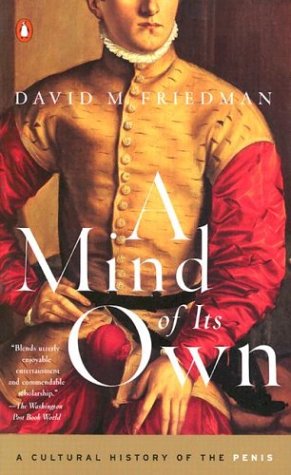
A Mind of Its Own: A Cultural History of the Penis, by David Friedman

The title of this book suggests it’s one of those novelty books that you buy as a gag for someone. The title, I presume, comes from Da Vinci’s ruminations that the penis behaves independently of its owner. An entire book devoted to the penis? This is a kind of interesting book, but not really a compelling read.

There were sections, like on the discovery of sperm, that I felt my eyes glazing over. Plus the long last chapter on Viagra and the goal of creating erections on demand I found a bit dull. If you had a scientific mind you might find these sections of interest. For me, I preferred the bits on Freud, Da Vinci and racism.

In short, I guess you might shout ‘sex’ to grab everyone’s attention, but once you talk about it for too long, and in such detail, it’s bound to get boring. Maybe pornographer Larry Flynt is right, the only way to get people’s minds off sex is to give them more than they could possibly want, then they’ll be begging off soon enough.

Here’s my quick chapter summary:

The Demon Rod.

This chapter describes the religious, mainly Christian view, of the penis as the work of the devil. Most witches often testified to having seen the devil’s penis – and what a whopper it usually was.

The Gear Shift

Da Vinci here rules the day. His scientific approach, cutting up bodies to find nature’s secrets, brings a breakthrough. Not air, or wind causes erections, but blood. Nice drawings too from Da Vinci, although he botched it slightly by drawing two tubes within the penis – one for urine, one for semen.

The Measuring Stick

This is all about the African penis. Is it the longest? The superior length of the coloured man’s penis was thought evidence, by the white man, of his moral depravity. African man was closer to animal than human. I liked how the author also took photographer Robert Mapplethorpe to task for his photographs of black men, saying he was no better than whites of a hundred years ago.

The Cigar

Freud and the penis. Perhaps enough said. He underwent a vasectomy because he believed it gave you a more potent sexuality. Nuts.

The Battering Ram

The second wave of feminism, and its opinion of the penis as a violent battering ram. You probably know enough about this too. Here are the key writers: Andrea Dworkin, Kate Millett, Betty Friedan, Germaine Greer, Shere Hite. Oh, and their arch nemesis, Normal Mailer. Remember the famous debate between Mailer and Greer? I wish we could get that on DVD.

The Puncture Proof Balloon.

Viagra, Viagra, Viagra. Apparently, scientists aren’t fully aware of the drug's possible side effects later down the track. Personally, I can’t think of anything more ridiculous than an old man, way past his prime, taking Viagra. Look at Hugh Heffner, in his seventies with all those young girlfriends. Well, I guess he seems happy enough.

Hmmm. This book kind of left me with an empty feeling. Don’t bother with it, unless you are penis obsessed. Read Freud and Da Vinci instead. And study the history of racism. Your time would be spent more profitably I think.