Showing posts with label European History. Show all posts

Saturday, June 27, 2020

Promise Me You'll Shoot Yourself: The Mass Suicide of Ordinary Germans in 1945, by Florian Huber.

In 1945, a shocking wave of suicides spread across Germany...

As Soviet troops advanced on Nazi Germany, and all seemed utterly hopeless, large numbers of German citizens chose not only suicide for themselves, but suicide for their families as well.  Florian Huber pieces together a chilling, tragic and sometimes bizarre narrative of ordinary Germans trapped in circumstances of their own blind making. Once Hitler had committed suicide, on April 30, 1945, there was no conceivable path out of the national madness he had created. Hitler was all; extraordinary numbers of Germans believed he was a virtual messiah, come to save them. When news got out of the death camps and gas chambers, Germans muttered that Hitler couldn't have known. If he had known, he wouldn't have allowed it to happen. Popular delusions ran deep.

Promise Me You'll Shoot Yourself (named after a father who gave his daughter a gun, told her to run and then kill herself) has two major parts. The first is a history of that wave of 1945 suicides, the story of a people immobilised by fear and lacking any moral compass; the second part tries to analyse why Germans got taken in by Hitler. The harsh terms set out for Germany by the Treaty of Versailles, after the First World War, goes some way to explaining Hitler's popularity, but not all. So much still remains an enigma.

The most fascinating parts of the book discuss political scientist Hannah Arendt's experiences  on returning to Germany after the war. Ordinary Germans, she discovered, remained indifferent or unwilling to face the crimes of the Nazi regime. These callous, self-pitying responses left Arendt in a state of shock.

A fascinating addition to the history of Nazi Germany, using contemporary diary entries and letters to explain the mindset and attitudes of ordinary Germans who created for themselves a  horrific nightmare.   

Promise Me You'll Shoot Yourself: The Mass Suicide of Ordinary Germans in 1945, by Florian Huber. Text Publishing. $32.99

First published August 2019 at northmelbournebooks.com.au


Saturday, November 25, 2017

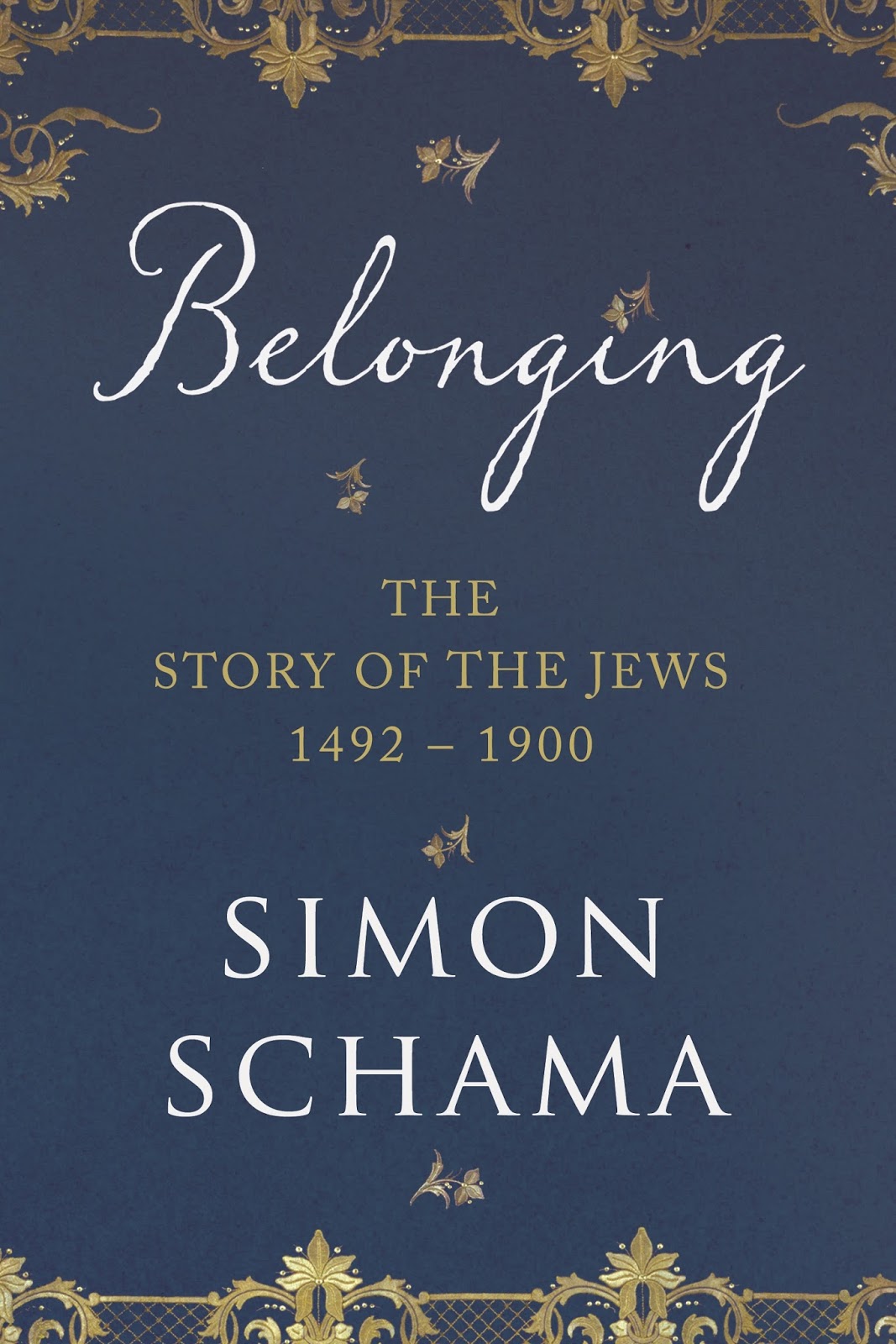
Belonging: The Story of the Jews 1492 - 1900, by Simon Schama

Staff review by Chris Saliba

Simon Schama's Jewish history is warm, witty and life affirming.

Simon Schama’s Belonging: The Story of the Jews 1492 – 1900 is the second instalment of his esteemed Jewish history, following Finding the Words 1000-1492.  The story starts with David the Reubenite, a fifteenth century Jewish mystic who believed himself to be a member of the original Biblical tribe of Reuben and ends with Theodor Herzl, the political activist and writer who is considered one of the founders of the Jewish state in Palestine. In between there is a cast of men and women –  business people, philosophers, writers, political activists, religious leaders – who have shaped the extraordinary history of the Jews. It’s a story of survival, both physical and spiritual, against thousands of years of deeply ingrained oppression.

Jews did not have a nation state to call home, where they could properly defend themselves and seek asylum, until 1948. Until that time, the Jews had to live on the goodwill (of which there was next to none) of their host countries. They led precarious lives, especially in Christian Europe, where the Catholic Church’s Inquisition was in full flight. Being Jewish, you always had to be one step ahead of political developments. Nothing could be taken for granted. Basic rights could be taken at any time, humiliations meted out at any Christian’s whim or arbitrary expulsion from the host country.  When the Habsburg empress Maria Theresa decided to expell the Jews out of Prague, some 30,000 souls had to leave and find asylum in a hostile Europe.

To read this history of the Jews is to also read a history of anti-Semitism. The facts alone of how Jews were treated makes the reader draw breath in astonishment. The Christian imagination was deeply immersed in lurid fantasies of the Jews as demons and hobgoblins. The most persistent Christian belief was in a blood libel – the accusation that Jews kidnapped and killed Christian children, using their blood in Jewish rituals. Such ridiculous beliefs were upheld and promoted not just by the church’s hoi polloi, but by its leaders, priests and popes. No wonder pogroms against the Jews were so vicious.

Despite this, in the centuries leading up to the twentieth, Jews did make breakthroughs (although there was always the feeling that these advances were on shaky ground as irrational anti-Semitism could flare up at any time). Jews found some liberation in the ghettos of Venice, in 1616 the Dutch republic relaxed its rules and allowed the building of synagogues and in England Jews in the 18th and 19th centuries found some degree of acceptance. Of course one of the greatest countries for Jews would be the United States of America, with its guarantee of religious freedom.

Simon Schama writes a bustling, generous and witty history. He covers the general sweep of Jewish progress, but also has a fascination, even love, for the great characters of that story. His vivid descriptions of congested, busy life in the ghetto, its jostle of Jewish culture, food, dress and religious practice, brims with humanity. A book that weighs the triumph and tragedy of the Jews in equal measure, that celebrates as much as it commiserates.

Belonging: The Story of the Jews 1492 - 1900, by Simon Schama. Published by Jonathan Cape. ISBN: 9781847922816 RRP: $35

To sign up for our monthly newsletter, featuring new releases, book reviews and favourite articles from around the web, click here.

Tuesday, September 12, 2017

Blitzed: Drugs in Nazi Germany, by Norman Ohler


Staff review by Chris Saliba


The untold story of how German society and its leadership got hooked on drugs. 

Millions upon millions of words have been written trying to figure out the enigma of why Germany followed a murderous dictator like Hitler to their ultimate ruin. Enter German historian and novelist Norman Ohler. His thesis is that the Germans could not face the reality of their defeat in 1914 and took refuge in self-delusion. To immunise themselves against reality, the country took to drugs. All levels of society were involved: civilian, military and the elite leadership.

The German wonder drug was Pervitin, a synthetic methamphetamine, what's known as a methylamphetamine. It was sold extensively and even came laced in commercially made chocolates. As Ohler writes, “Pervitin spread among all social circles...Doctors treated themselves with it, businessmen who had to rush from meeting to meeting pepped themselves up; party members did the same, and so did the SS. Stress declined, sexual appetite increased, and motivation was artificially increased.”

The military were soon using it as well. Germany's stunning early successes against Britain and France can be attributed to its soldiers being high on methamphetamines. The reason Hitler stopped the onward march of his soldiers at Dunkirk was because he didn't know of their drug use. He couldn't understand their sudden military successes and felt the army was at risk of running on ahead of him.

Hitler, however, would turn out to be the biggest junkie of them all. He placed great faith in his personal physician, Theodor Morell, who kept him pumped up on a wild cocktail of animal hormones and opioids, most notably Eukodal. Hitler was attending some of his most serious military meetings high as a kite, according to Ohler. By the war's end, Hitler was a physical and psychological write-off. The great mystery is: how did he allow himself to be taken in by Theodor Morell, such an obvious quack?

Blitzed provides a fascinating study of the German body and mind during the Nazi period. It tells of how a population, believing itself to be physically and mentally pure, was hopelessly addicted to mind altering substances.

Blitzed: Drugs in Nazi Germany, by Norman Ohler. Published by Penguin. ISBN: 9780141983165 RRP: $24.99

To sign up for our monthly newsletter, featuring new releases, book reviews and favourite articles from around the web, click here.

Saturday, January 9, 2016

Late Fame, by Arthur Schnitzler

Staff review by Chris Saliba

A gently comic novella about the impetuosity of youth and the humble pleasures of old age. 


Herr Eduard Saxberger is an elderly German civil servant. In his youth he had enjoyed some fame for his slim volume of poems the Wanderings, but that is all behind him now. Imagine his surprise when one evening he arrives home to find a youthful literary admirer. Wolfgang Meier is the leader of a Viennese literary clique called the “Enthusiam” society. He has recently discovered the long forgotten the Wanderings. In a fervour of adulation, Meier and his society of impetuous young writers decide to adopt Saxberger as one of their own. At first the old civil servant is charmed, but soon the novelty loses its sparkle. In a series of comic misunderstandings, it becomes increasingly clear that the young writers and the old poet are not on the same page. They don't really understand each other at all and much of their friendship has been a comedy of errors.

Arthur Schnitzler (1862-1931) wrote this beautifully controlled novella in the mid 1890s. Some 120 years later it is now published for the first time. With elegance and simplicity, he has written a gently comic story that shows how time eventually erodes our youthful illusions, giving way to the more prosaic yet dependable pleasures of age.

Late Fame, by Arthur Schnitzler. Published by Pushkin Press. ISBN: 9781782271321  RRP: $26.99

To sign up for our monthly newsletter, featuring new releases, book reviews and favourite articles from around the web, click here.

Thursday, August 6, 2015

The Sleepwalkers: How Europe Went to War in 1914, by Christopher Clark

Staff review by Chris Saliba

In this elegant and exhaustively researched history, Australian historian Christopher Clark endeavours to explain the complicated and often irrational politics that led to the First World War.

One hundred years on from the First World War, Australian historian Christopher Clark has dug deeply into the war literature to try and figure out how and why it started. The result is perhaps more confusion. If anything, there appears to have been a lack of clarity on the part of Europe’s political elites. Politicians, diplomats and monarchs all worked at cross purposes. Adding to the mess was the sheer number of countries that jostled amongst themselves for power, prestige and position.

It’s a great credit to Christopher Clark that he can work such a bewildering mess of information into a manageable narrative. The Sleepwalkers starts in Serbia, examining the Pan-Slavic movement that aimed to unite all Slavic people. It is perhaps Serbia that is emblematic of the confused and contradictory politics that was rife throughout early twentieth century Europe. Serbia had a monarchy and a civilian political class that didn’t work in concert. The Serbians also had a bad habit of murdering their kings and queens. Added to this was a secret underground web of Serbian nationalist groups keen to undermine their neighbour, Austria-Hungary. The civilian politicians knew about these shady groups, watched them with keen interest, but didn’t try to rein them in. Out of this potent mix came the six assassins who plotted the murder of Archduke Franz Ferdinand. It was Gavrilo Princip that would fire the shots that killed the Archduke and his wife, triggering the First World War.

The Sleepwalkers examines all the other European countries at war and the peculiarities of their political systems, showing how communication and messaging was often poor, nonexistent or simply contradictory. Not only did these countries have poor internal systems of communication, their international communication was worse. Nor was Europe served by a particularly brilliant set of leaders. Many were vain, lazy thinkers living in a fairy land of imperial illusions. They led rich, technically advanced nations and spent huge amounts building up their armies, without much thought about the consequences of unleashing so much cutting edge weaponry. There’s a fair degree of magic thinking on the part of Europe’s leaders at this time. Romantic and unrealistic ideas of war prevailed.

Interestingly, Clark’s revisionary history doesn’t find Germany to be the power mad monster of popular imagination, while Great Britain is shown to be condescending to other European nation states, often exacerbating antagonisms. This is a brilliant history that combines shrewd analysis with exhaustive research. Clark’s writing is sophisticated and intelligent. His overall thesis passes the common sense test. There is much to satisfy in this magisterial work.

The Sleepwalkers: How Europe Went to War in 1914, by Christopher Clark. Published by Penguin. ISBN: 9780141027821  RRP: $24.99

To sign up for our monthly newsletter, featuring new releases, book reviews and favourite articles from around the web, click here.

Saturday, May 24, 2014

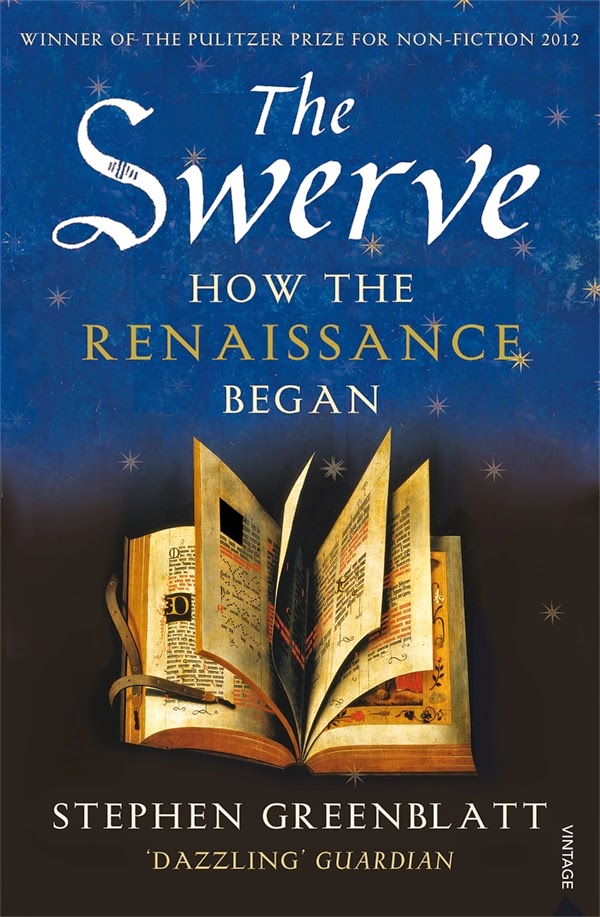
The Swerve: How the Renaissance Began, by Stephen Greenblatt

Staff Review by Chris Saliba

Stephen Greenblatt's The Swerve covers issues of momentous cultural, intellectual and religious significance over a 1500 year period. It's also a deeply satisfying read, with Lucretius's liberating Epicurean philosophy forming the book's core.

If you’re a hopeless booklover, then you’ll most likely find this a richly rewarding read. The subject, on the face of it, doesn’t really seem like much: a fifteenth century Italian scholar, named Poggio Bracciolini, discovered in a German monastery in 1417 a forgotten book by the Roman poet Lucretius (99BC – 55 BC). The book was called De Rerum Natura, or as commonly translated into English, On the Nature of Things. From these simple historical facts Stephen Greenblatt spins out a most splendid book, discussing in depth subjects integral to the development of Western religious and intellectual thought.

The Swerve really turns between two worlds, the Roman world of Lucretius, and the Christian world of the fifteenth century. Poggio Bracciolini as a scholar who worked under seven popes, was a book hunter, someone who trawled through the libraries of monasteries trying to find interesting books. To the modern reader, this all seems quite extraordinary, especially now in the age of Google where everything is at your fingertips. Greenblatt gives a fascinating history of the production of books during these times. Monks would copy out books by hand and were also the guardians of these libraries. The classical texts that have come down to us today, Plato, Aristotle etc. were never recovered in their original or contemporary forms. They were rather copies.

The production of books in the ancient world also has an amazing story. I’ve read many classical authors, but never given too much thought to how books were produced in those times. I just presumed Plato chiselled Greek characters onto a tablet somewhere. Book production was quite an industry in the classical world. They were written onto papyrus, which was a fairly sturdy paper and could last for decades if carefully looked after. Teams of copyists would produce a book by having someone (usually a slave) read the book aloud. What happened to all those original books by the Greeks and Romans? As Christianity rose, libraries, with their Pagan books, fell into disfavour. Their upkeep diminished and the books crumbled away, mostly eaten by bookworms.

The Renaissance, however, saw a surge in interest in these classical texts. Despite this, there were tensions. Frequently the subject matter and philosophical direction of these works were not in harmony with Christian theology. Nowhere is this more striking than with Lucretius’s philosophical poem, De Rerum Natura. In it he espoused the philosophy of Epicurus, who believed we should live for pleasure and the simple things in life. On a more heretical note, it espoused a theory of atomism which proposes that everything is broken down into indestructible parts. In essence, this theory posited that the world was a pretty random place, not the well planned cosmos of a single Christian God. Advocating such a theory, as did the Dominican friar Giordano Bruno, could get you burnt at the stake, which is just what happened to him. I felt a cold hand gripping my heart as I read the horrible fate of this highly original thinker. The church was obviously interested in nothing less than absolute power. Alternate views to life and the universe the church felt should be dealt with by the most agonising death.

Lastly, of course, there is the poem, which as Greenblatt digests its contents, sounds like essential reading. The author warns that the language can be a little difficult, but that perseverance is handsomely rewarded. I’m not sure if I’ll ever get around to reading On the Nature of Things, but I certainly hope to. Its Epicurean philosophy of living simply in the here and now, enjoying pleasure where you can, watching life in a detached manner, sounds very liberating.

The Swerve is a book you enjoy slowly and that rewards handsomely with its author's erudition and passion for his subject. 

The Swerve: How the Renaissance Began, by Stephen Greenblatt. Published by Vintage Arrow. ISBN: 9780099572442 RRP: $19.99

To sign up for our monthly newsletter, featuring new releases, book reviews and favourite articles from around the web, click here.