Showing posts with label Asian Fiction. Show all posts

Thursday, March 6, 2025

Tiananmen Square, by Lai Wen

The Tiananmen Square protests are vividly evoked in this remarkable work of autobiographical fiction.

Lai lives with her parents, grandmother and brother in a rundown apartment in Beijing. The family is relatively poor. Lai’s father is withdrawn, while Lai’s mother is resentful at her lot. Lai’s closest relationship is with her down-to-earth grandmother. When Lai wins a scholarship to Peking University, it opens up a new world. She begins a painful romance with the idealistic Gen, which is offset by a demanding yet exhilarating friendship with the theatrical Anna. It’s a time of student unrest as protests are made for more freedom, and Lai finds herself inexorably caught in this maelstrom.

Lai Wen (a pseudonym) was born in Beijing in 1970 and left the country just after the Tiananmen protests in 1989. Tiananmen Square is an absorbing, carefully written coming-of-age novel that captures the emotional whirlpool of student life in late 1980s China, with a diverse cast of characters and some surprising events (including a gay marriage during the protests). Lai Wen is a compelling witness to history, someone who has brooded on her story for 35 years before finally deciding to tell it. A moving and profound story about power, resistance and its terrible consequences.

Tiananmen Square, by Lai Wen. Published by Swift Press. $34.99

OCT 24

Saturday, November 7, 2020

Braised Pork, by An Yu

A young woman goes on a journey of self-discovery in this intimate, understated debut from Chinese author, An Yu.

Jia Jia lives in her Beijing apartment with her husband, Chen Hang, a successful businessman. It's more a marriage of convenience than love, and there are suggestions that not all his business dealings are above board. One morning Jia Jia walks into the bathroom of their apartment to find her husband in the bath, his head submerged. Nearby is a strange, enigmatic drawing he has made of a man with a fish's body, what comes to be called “the fish man”. Was it suicide, or accidental death? Maybe something more sinister?

Left alone in the world with a large, four-bedroom apartment, Jia Jia embarks on an uncertain new life, one of self re-creation. She strikes up a friendship with Leo, who runs a bar near her apartment, and takes on some freelance work as an artist. The idea then strikes her to take a trip to Tibet, replicating the exact journey her husband had taken before his untimely death.

In Tibet Jia Jia meets some new people who help her unlock the mystery of “the fish man”, the strange picture her husband had drawn before he died. In the process, new information is also revealed about her troubled mother, who died young.

Braised Pork is the first novel by 26-year-old An Yu. She was born and raised in Beijing, moved to New York as a teenager and now lives between Paris and Hong Kong. She writes her fiction in English. This is an engaging and elusive debut - elusive in a good way. The story is set out in clear and simple prose – it’s a dream to read – and is rich in ambience, describing city life and its feelings of isolation. As the story progresses, it becomes more evocative and contains many dream passages where Jia Jia falls into what is described as a “world of water” that is linked to “the fish man”. This world of water could be described as a state of being, almost a state of nothingness, that offers relief from Jia Jia's grief and depression. In the world of water, Jia Jia doesn't have to be anything, but can be happy to simply exist. It's a dark, yet meditative place.

Some readers may find Braised Pork too abstract and intangible. The more evocative dream sequences can leave you scratching your head as to what it all really means. But too much explanation could have tipped this sensitive and delicate story, with its strong vein of magic realism, into something more blunt and prosaic.

A highly enjoyable debut and an author to watch.

Braised Pork, by An Yu. Published by Harvill/Secker. $29.99

Review by Chris Saliba

First published December 2019 at northmelbournebooks.com.au

Friday, July 19, 2019

China Dream, by Ma Jian

A buffoonish, pleasure-seeking state bureaucrat tries to suppress nightmare memories from his past.

Ma Daode has recently been appointed director of the China Dream Bureau. The Bureau’s project is one of national rejuvenation, a restatement of Communistic values. Ma decides the best way to do this is by erasing troubling memories of the past. He works on the idea of a ‘neural implant’, a chip that would be implanted in the brain, allowing the subject to live more perfectly the China Dream.

All should be going well for Ma. He has position, authority, wealth and a virtual harem of lovers. If only he weren’t troubled by such terrible memories, horrific images from his past. The worst memories are from the Cultural Revolution. In his youth Ma denounced his parents as “rightists”, joined a political faction and involved himself in killing, betrayal and ritual humiliations. His parents committed suicide and he can never forgive himself.

It is torture for Ma, trying to forget. He tries all sorts of diversions, but nothing works. Eventually he goes to a Qigong healer, Master Wang, who gives him a recipe for a concoction that will hopefully help him forget.

Chinese author Ma Jian, an exiled dissident who now lives in London, found the idea for this novel from President Xi Jinping’s call for a “China Dream of national rejuvenation”, one that would maintain economic success and restore China to its former glory. The novel is part satire and part political allegory, a study of the conflicted nature of the Chinese national psyche: past horrors such as the Cultural Revolution  must be expunged from memory, even though they form a vital part of the country’s history.

China Dream is written with concision and clarity, perfectly animating its surreal and absurdist subject matter (full marks to Flora Drew’s superb translation). The character of Ma Daode is described almost as an affable fool. It’s easy to feel some sympathy for this clownish bungler, despite the terrible confessions from his past. Ma Jian’s surreal and ironic novel is reminiscent of Russian greats such as Dostoyevsky, Gogol and Bulgakov. It’s a work that examines the deep contradictions found in any national character that tries to suppress its past and has a universality beyond being a spoof of President Xi Jinping’s state propaganda.

China Dream, by Ma Jian. Published by Chatto and Windus. RRP: $32.99

Friday, April 12, 2019

If Cats Disappeared from the World, by Genki Kawamura

A young man is asked to make a bargain with the devil, putting his beloved pet cat, Cabbage, at risk. 

The unnamed narrator, a young man who works as a postman, discovers he has a terminal brain tumour. He doesn’t have long to live. Out of nowhere the devil appears, dressed in a flamboyant Hawaiian shirt, shorts and sunglasses, as though he were on holiday. His personality matches his breezy attire. 

The devil makes a bargain with the young man: he can have an additional day of life, but for each day he must make something disappear from the world. At first he trades mobile phones. They disappear from the world, not such a bad thing he decides. The choices, however, become increasingly difficult, as the devil demands things disappear that have special meaning for the young man. Then comes the ultimate test: he is asked to make cats disappear from the world to live an extra day. 

This causes the young man to think deeply. He has a pet cat called Cabbage who he is very close to. Cabbage was found many years ago by his recently deceased mother. Understandably, Cabbage carries all sorts of meaning, bringing memories of time spent with his family. Especially his father, who is still alive, but from whom the young man is estranged.

The basic plot outline of this short novel by Japanese author Genki Kawamura sounds grim and cheerless, but the tone is quite comic and whimsical (the young man calls the devil “Aloha”, due to his colourful shirts). Kawamura infuses his story with a light and playful tone. It enchants with its earnestness, quirky dialogue, likable characters and amusing, oddball digressions. 

At heart the book is about what we need and what we don’t need, what’s most important in life and what sustains us. It’s about the fragility of life, the bonds of family and the importance of maintaining our relationships with those we love.

An unusual little gem that quickly grows on you.  

If Cats Disappeared from the World, by Genki Kawamura. Published by Picador. RRP: $18.99

Thursday, November 22, 2018

Men Without Women: Stories, by Haruki Murakami


Murakami’s new collection of short stories is addictive and enchanting.

If there’s one writer whose work we sell consistently, it’s that of Haruki Murakami. No other author compares. For years I’ve had people tell me how much they love him and why I should read him. A long time ago I tried Kafka on the Shore, but gave it up after twenty or so pages. Maybe I wasn’t in the right mood, I don’t know. Recently a spare copy of his short story collection, Men Without Women, fell into my hands so I thought I’d give it a go.

The seven stories that make up Men Without Women don’t necessarily follow the title’s theme. In fact, the book probably explores the opposite, how men and women are inextricably interdependent, emotionally and psychologically. Several stories grasp at trying to understand women, particularly in relationships, and why they might act as they do.

In “Drive My Car”, a veteran actor hires a driver due to problems with his eyesight. Soon the two open up a dialogue and the actor talks about his wife, recently deceased, who also cheated on him.  The actor shows no anger at his wife’s infidelities, but merely wants to understand her. “Yesterday” tells of a writer who recalls an old friend and his ambivalent relationship  to his girlfriend.  The book’s title story, "Men Without Women", opens with a man receiving a phone call from the husband of a former girlfriend who has committed suicide. This bad news brings on melancholy reveries of the past, as the man tries to figure out what could have led her to take such a drastic step. Other stories are more quirky. “Samsa in Love” is Murakami’s take on Kafka’s famous story, “Metamorphosis”, while in “Scheherazade”, a middle aged woman tells the man she works for stories from her past, most notably when she was a teenager and would repeatedly break into the bedroom of a boy her age and steal personal items, such as clothing, treating them almost as holy relics.

I found these stories utterly addictive and enchanting. It’s no wonder Murakami has so many fans. His writing has an existentialist flavour, but is warm and human. So many of the stories deal with solitary men and women, trying to fathom life’s mysteries. There’s a sympathy and honesty in this collection of shorter fiction. Murakami gets to the heart of things, in a very appealing, intimate prose.

Men Without Women: Stories, by Haruki Murakami. Published by Vintage. ISBN: 9781784705374  RRP: $19.99


Wednesday, June 6, 2018

Botchan, by Soseki Natsume


Staff review by Chris Saliba

Botchan is an early novel by Soseki Natsume, one of Japan's most famous writers. First published in 1906, it is still widely read in Japan today and enjoys classic status.

When first his mother, then his father dies, Botchan (boy master) is given 600 yen by his older brother. He uses the money to study physics for three years. When Botchan graduates, he takes up a post teaching mathematics in a middle-school in Matsuyama on the island of Shikoku. All should go well, but soon Botchan finds himself entangled in an intricate web of workplace politics. The head teacher, nicknamed Red Shirt, seems the picture of decency and probity, but it soon turns out that he is quite duplicitious. When Red Shirt tries to have one teacher sent to another post and Botchan's name besmirched in a local newspaper, Botchan knows he must teach the head teacher a lesson, a “Heaven-commissioned punishment”.

Botchan tells his own story in this humane and gently comic novel. His style is rather pompous and self-important, like one of Dickens' grandly deluded characters. Yet underneath his pretensions and formality (Botchan constantly refers to himself as a “Kedo man”, from a long, aristocratic line) there resides a simple man of basic moral values. He can only countenance doing right in the world and where he sees lies and deceit, he feels it incumbent upon him to seek justice and truth. The enduring popularity of the novel obviously derives from Botchan's plain honesty intertwined with his comic bufoonery.

Natsume's early classic is the tale of a simple everyman and eccentric whose sense of decency prevails in a world full of charlatans and double dealers.

Botchan, by Soseki Natsume. Published by Tuttle. ISBN: 9784805312636  RRP: $14.99

To sign up for our monthly newsletter, featuring new releases, book reviews and favourite articles from around the web, click here.

Saturday, March 3, 2018

Spring Garden, by Tomoka Shibasaki

Staff review by Chris Saliba

A mysterious sky-blue house brings together two strangers in a nearby apartment block.

Divorced three years ago, Taro lives alone in a block of eight flats. The flats have a slightly eerie, desolate feel as they are slated to be torn down and replaced with new ones. Taro is an introverted young man, still in his early thirties, and he spends much time thinking about his father who recently died. Next to the block of flats there are several other interesting buildings, most notably a sky-blue house, an architectural curio from the 1960s.

When Taro strikes up a friendship with the unconventional Nishi, a woman who lives in the flat above him, he learns that she has an obsession with the sky-blue house. In her youth, when she was at school, she remembered a picture book that was especially devoted to this blue house and was called Spring Garden. The book was put together by the original occupants, an outré, arty type of couple. The curious book featured pictures of the couple lounging around the various rooms of the house looking enigmatic. Nishi by chance came across the blue-sky house again when searching for a new place to live and so she moved into Taro's block of flats, with its direct view of the house.

The friendship between Taro and Nishi is cemented as they become intrigued by the curious book, Spring Garden, and speculate about what the house must be like inside. When a new family takes up residence in the sky-blue house, they get their chance.

Tomoka Shibasaki's 2014 novel, beautifully translated by Polly Barton, is a sensitive and intimate account of a spontaneous friendship between strangers, set against a delicately drawn backdrop of a transitory and ethereal urban environment. The descriptions of the mysterious sky-blue house, the other odd buildings, the lane ways, streets and idiosyncratic gardens, with their trees and wildly growing vines, will appeal to anyone who has been intrigued by the cultural and emotional significance of houses.

Spring Garden evokes feelings of isolation, introspection, and fleeting human connection in the midst of a densely populated city. A gorgeously delicate and intimate read. 

Spring Garden, by Tomoka Shibasaki. Published by Pushkin. ISBN: 9781782272700 RRP: $19.99

To sign up for our monthly newsletter, featuring new releases, book reviews and favourite articles from around the web, click here.


Friday, June 16, 2017

The Accusation: Forbidden Stories from Inside North Korea, by Bandi


Staff review by Chris Saliba

A compelling collection of stories that go some way to explaining life in North Korea.

Bandi is the pen name of an anonymous North Korean writer. The Accusation: Forbidden Stories from Inside North Korea comprises eight short stories, each about thirty pages long, written between 1989 and 1995. The manuscript was recently smuggled out of North Korea and is published for the first time. Bandi (the word means “firefly”) still lives in North Korea.

The stories describe many aspects of North Korean life. The wife of a man whose relatives have been denounced by the Party secretly takes contraceptive pills because she can't bear to think what fate her child might have; a couple are dragged off to jail because their young son was scared of a portrait of Karl Marx; a man who has spent his life faithful to the Party suddenly realises he has been duped by socialism's promise and becomes so consumed with rage he has a heart attack; an elderly woman has a chance meeting with Kim Il-sung (“the Great Leader, Father of Us All”) and is crippled with absolute terror.

This is an extraordinary collection. Bandi's stories are lucidly written, with an emphasis on individual characters faced with impossible situations. They are completely absorbing and explain the mindset and sufferings of those living under a totalitarian regime. Essential reading.

The Accusation: Forbidden Stories from Inside North Korea, by Bandi. Published by Serptent's Tail. ISBN: 9781781258712 RRP: $27.99

To sign up for our monthly newsletter, featuring new releases, book reviews and favourite articles from around the web, click here.

Friday, January 27, 2017

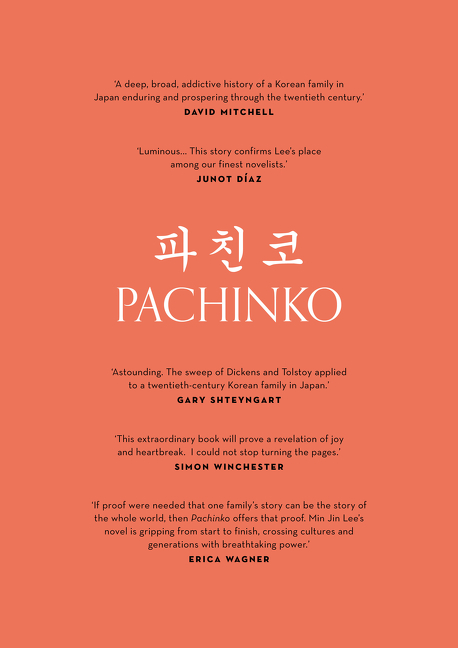
Pachinko, by Min Jin Lee

Staff review by Chris Saliba

In this ambitious historical novel, chronicling four generations of a Korean family and covering most of the 20th century, Min Jin Lee explores complex issues of Korean identity shaped by war, Japanese colonialism and displacement.

In 1910, the year Japan annexed Korea, a girl, Sunja, is born to a peasant couple, Hoonie and Yanjin. She is the couple's first child to survive; three previous infants had sadly died. Sunja grows into a fine young woman, but when she becomes romantically involved with Koh Hansu, things become complicated. She falls pregnant, but naively thinks Hansu will marry her. Hansu, who is a yazuka (roughly translated, a crime boss) is married and has a family in Japan. When Sunja finds this out, she refuses to see him again. Pregnant, without a husband, what is she to do? A boarder with the family, a Christian minister named Isak, steps in with an offer. He will marry Sunja and take responsibility for the child, but she must move with him to Japan, where he does missionary work.

The first half of the novel concentrates on Sunja's life in Japan and her struggles to survive in a country where Koreans are treated as second class citizens. After her first son, Noa, is born, she has a second son to Isak, named Mozasu.  When Isak dies after mistreatment in a Japanese prison near the end of the Second World War (his Christian missionary work makes him appear as a radical to the authorities), Sunja tries to eke out a living by selling her homemade kimchi. 

The second half of the novel concentrates on the adult lives of Noa and Mozasu. The narrative leaps along here, many years passing with each chapter, giving the story the feel of a runaway train. It seems to go in all directions and you never know what's going to happen next. Many of the characters' lives become emotionally messy and fraught. There are shock suicides, infidelities, scenes of promiscuous sex and underhand business dealings (Koreans had limited work opportunities in Japan). Noa studies English literature, but like his brother, Mozasu, eventually makes all of his money by running pachinko parlours, places almost similar to our pokie venues.

Pachinko makes for an absorbing reading experience. The narrative is powered along by a broad cast of fascinating and complex characters. The story also benefits from much obvious research, giving the book an authentic ring (Min Jin wrote the book while living in Japan and interviewed many Japanese Koreans.) The novel doesn't resolve the fractured and divided psyches of the main characters, offering no neat psychological shorthand for their personal traumas, but rather puts on the table with emotional rawness the difficulties of being a third or fourth generation Korean, exiled from the mother country.

Pachinko, by Min Jin Lee. Published by Head of Zeus. ISBN:  9781786691361 RRP: $32.99

(Released 1st February, 2017)

To sign up for our monthly newsletter, featuring new releases, book reviews and favourite articles from around the web, click here.