Showing posts with label Psychology. Show all posts

Monday, March 10, 2025

Confessions of a Sociopath, by M.E. Thomas

A clinically diagnosed sociopath tells her story

Confessions of a Sociopath by M.E. Thomas (a pseudonym, as you can imagine), was first published in 2012 and is now re-issued in a Picador paperback. Thomas, whose clinical diagnosis as a sociopath prefaces the book, wrote Confessions as part explainer of her condition and part plea (this may sound strange) for more tolerance of sociopaths. 

Despite the alarming subject matter, and the author’s openness about her abilities to manipulate and ruin people (it is worth noting here that she is non-criminal and non violent), 
Confessions makes for a gripping, insightful and often darkly amusing read. M.E. Thomas writes with wit and precision about the psychology of sociopaths and examines whether they are born or made. The author’s work as a lawyer and academic comes through in her razor sharp analysis and highly original view of the world. She also makes many interesting references to literature and science when making her points, discussing sociopathic characters in the great novels.

Sociopaths are renowned for their lack of remorse, guilt or negative emotions. As M.E. Thomas slices and dices how we all behave - our guilt, vulnerabilities and weak spots, also our aggressions and tendency to try and manipulate the world - it feels like a confronting therapy session. Strangely enough, Confessions could almost double as a self-help manual. The book prompts self-analysis.

It does seem unlikely that a sociopath should write a book and essentially give the game away  (sociopaths like to work in the shadows.) But Thomas hopes that by explaining her condition, that sociopaths might be able to live more in the open. She lists all the types of work that sociopaths are good at, such as the law and high level business. They see more clearly because they’re less likely to get emotionally involved. She also argues (backing this up with research) that sociopaths brought up in good homes, given structure and an education framework, are less likely to offend criminally. (Thomas was brought up Christian and still practices her faith, writing that religion gives her a rulebook that keeps her out of trouble.)

Confessions of a Sociopath
 is an unforgettable book. A true original. It rips the mask off the world, showing a side we rarely contemplate in nuanced detail. A must read.

Confessions of a Sociopath, by M.E. Thomas. Published by Picador. $24.99

FEB 25

Friday, February 24, 2017

Reclaiming Conversation, by Sherry Turkle

Staff review by Chris Saliba

A fascinating and deeply researched look at what communication via digital technology is doing to human relations. A must read.

Sherry Turkle, a clinical psychologist, researcher and author, has been studying the impact of digital technology on humans for three decades, publishing many books on the subject. Her latest, Reclaiming Conversation, argues that our obsession with technology has caused us to neglect our conversational skills. The good news is these conversational skills can, with effort and determination, be exercised again like a muscle and strengthened. Better still, good conversation, as opposed to the weakened and shallow exchanges we have via technology, has the power to heal, to bring greater understanding of the self and others, to even enhance our capacity for empathy.

This is the light at the end of the tunnel, the payoff if we turn more to each other instead of our phones. Reclaiming Conversation sounds like a self-help book, a sunny guide to improved human relations. It’s not. What Turkle examines in careful detail for 360 pages is how digital  technology has had an adverse effect on our relationships. The most startling takeout from the book is a dramatic drop in the amount of empathy people exhibit (especially the young). Teachers report of their students treating each other in rather uncaring ways, basically because they don’t talk face-to-face. They have no idea how their words impact on others. This leads to the second big behavioural change that the book reports: people find relationships too difficult, even scary, so they prefer to use technology - texts, Facebook, social media - as a way of communicating. Technology is embraced as it allows users to create the perfect distance from one another - not too far away but not too close, either. Couples and families even make pacts to argue via technology; apparently this helps them keep their emotions in check.  

The net effect of all this texting and Twittering is that relationships are suffering. Friends and family when they are together prefer to look at their phones. Children complain that their parents bring phones and tablets to the dinner table and ignore them. When people are communicating by text, the language is constrained by the brevity of the messages. This is why emoticons are necessary, to try and convey more nuanced emotions. Text messages are delicate things, often open to misinterpretation by overly sensitive recipients. Don’t send a message with a blunt full stop, as it could be interpreted as anger. Add lots of cheerful exclamation marks instead.

Reclaiming Conversation can really be considered a sequel to Turkle’s 2011 book Alone Together, which examined human attitudes to robots and phone technology. This time around  Turkle looks deeper at communication via technology and what it is doing to us. The book is rich with utterly fascinating field research. The author’s training as a psychologist - Turkle is clearly a careful questioner and listener - comes through everywhere in the text. It’s like social media itself has been put on the analytical couch and given a diagnosis. That diagnosis is not good. Conversation via technology is creating a whole host of new anxieties, even though it is supposed to be smoothing out the rough spots of human interaction.

It’s hard to be optimistic that conversation will make a comeback and people will turn their phones off more regularly. Interestingly, Turkle says that parents need to set the right example and act as mentors to their children. At the moment they are not. The research in Reclaiming Conversation shows them to be even more obsessed with their phones than their children.

Reclaiming Conversation is Indispensable reading for anyone wanting to understand what’s happening to the collective psyche as everyone plugs into the Internet 24/7.

Reclaiming Conversation: The Power of Talk in a Digital Age, by Sherry Turkle. Published by Penguin. ISBN: 9780143109792  RRP: $26.99

To sign up for our monthly newsletter, featuring new releases, book reviews and favourite articles from around the web, click here.

Friday, January 20, 2017

When Strangers Meet: How People You Don't Know Can Transform You, by Kio Stark

Staff review by Chris Saliba

Kio Stark's short book on talking to strangers mixes sociology with practical advice on being out in public.  

Scientific research tells us that we feel good after having spoken to a stranger. A little positive human contact gives us a high. The interaction doesn't need to be significant. It can be just a simple "hello", or maybe a more involved exchange. There are lots of quirky, spontaneous, fleeting and yet quite revealing short interactions that author and teacher Kio Stark describes in this short TED book. Whether it be sitting at the bus stop or waiting in line at the bank, there are opportunities galore to delve beneath the orderly social fabric we all try to maintain. Beneath this smooth veneer we can discover a new world of insights; we can also learn to become more empathetic. 

While the subject matter of When Strangers Meet may seem a little glib or gimmicky, the book actually  provides a lot of analysis concerning how our public spaces function. Kio Stark explores the politics and psychodynamics of public space: how we interact with people of different genders and races, the line we draw between the personal and private when dealing with strangers, the public performance involved in our interactions and a host of other intricate behaviours.

Stark relies a lot on the work of Erving Goffman, the Canadian-American sociologist who studied how we present ourselves and unconsciously perform in public. In many ways, When Strangers Meet is a variation on his work. It also works as a bit of an etiquette guide to being out in public.

This is a book that will make you re-think the world around you and how you interact with it.

When Strangers Meet: How People You Don't Know Can Transform You, by Kio Stark. Published by Simon and Schuster. ISBN: 9781471156090 RRP: $19.99

To sign up for our monthly newsletter, featuring new releases, book reviews and favourite articles from around the web, click here.

Thursday, August 11, 2016

A Place of Refuge: An Experiment in Communal Living: The Story of Windsor Hill Wood, by Tobias Jones

Staff review by Chris Saliba

Tobias Jones' page-turning memoir about his experiment in communal living is full of insights, empathy and understanding.

When British author and journalist Tobias Jones bought a gorgeous woodland property in Somerset, a county in South West England, he knew he'd made the perfect choice. What better place to raise his young family of three children with his Italian wife, Francesca. They would keep animals, grow their own vegetables, wake to the early song of birds in the morning and skip through wild flowers all the day long. His children would grow up enjoying the quietude of nature, spared much of the hurly-burly of modern day life, with its distractions and trivialities.

But Tobias Jones felt he had a calling. He wanted to turn him home into a commune for society's damaged and outcasts. A woodland refuge would be just the place for recovering alcoholics, the sexually abused, ex-soldiers suffering post traumatic stress and a host of other illnesses. So the family opened their doors and started taking in around five or six people at a time. The average time these guests would stay was about three to six months, sometime up to a year. A Place of Refuge is the story of that experiment, covering a five year period.

The most refreshing aspect of Jones' memoir is his honesty about the difficulties and frustrations of living communally with people who are severely damaged. This is no idyllic story of people walking through the gates of heaven and then finding miraculous, instantaneous healing. There are simmering tensions, individuals with persecution complexes and plain ignorant behaviour. Jones describes one guest who would leave his medication laying about, frequently on the floor. This wouldn't have been so bad on its own, its just that Jones' son, Leo, was a toddler at the time, fond of crawling about and sticking things in his mouth. Mealtimes could frequently be stressful, as guests would have poor hygiene and no table manners, rudely chomping through as much food as they could without thinking of others.

Despite all the frustrations and difficulties, there were breakthroughs. Troubled guests would improve during their stay. Many found the routine and work in the woodlands took their minds off their troubles. People who felt uncared for their whole lives knew there were people trying to look after their best interests.

A Place of Refuge provides a fascinating and empathetic study of society's fringe dwellers. It really is the type of book that makes you step back and take a deep breath as you confront people with serious problems that require understanding a patience. It's also a book full of engaging natural history. Jones' lovely descriptions of Windsor Hill Wood - the trees, the birds, the fresh air - makes you long to visit.

Wonderfully written and full of genuine insights into the human soul, A Place of Refuge is a book with much to teach.

A Place of Refuge: An Experiment in Communal Living: The Story of Windsor Hill Wood, by Tobias Jones. Published by Quercus. ISBN: 9781848662513  RRP: $19.99

To sign up for our monthly newsletter, featuring new releases, book reviews and favourite articles from around the web, click here.

Saturday, September 5, 2015

The Village Effect, by Susan Pinker

Staff review by Chris Saliba


Susan Pinker’s The Village Effect convincingly shows that the key to health and happiness lies in the quality of our relationships. She also argues that too much technology in the form of social media is diluting the quality of our personal interactions.

How important is it to have strong relationships, built on regular face-to-face contact? The answer is your life might depend on it, according to Canadian psychologist Susan Pinker. Pinker amasses a wealth of research to demonstrate that strong connections to other people not only benefit our well being, but also our physical health. People who maintain strong personal relationships enjoy better immunity to disease and experience swifter recovery from illness.

That’s the positive side. The dark side is modern society’s slide towards maintaining relationships through technology, rather than face-to-face interaction. Ironically, more friends on social media means more time spent alone in front of a screen. High users of technology tend to be lonely, according to the research. Education through technology is another area that Pinker devotes considerable time to. She convincingly argues that the move towards more computer use and less face-to-face teaching has resulted in poorer educational outcomes. The information superhighway, some 20 years old now, was supposed to lift academic achievement  across the board. Instead school results have remained stagnant, even fallen back slightly according to some studies.

The Village Effect is both depressing and inspiring. It’s depressing because of the world’s inexorable slide into using text and Facebook to conduct relationships (research shows that teens prefer texting to talking face-to-face because they find it too confronting.) It's Inspiring because it shows how face-to-face relationships and human contact have the power to enormously improve our lives. In a world rendered more artificial and spiritually thin through computer technology, harnessing this simple fact can give you an incredible advantage.   

Susan Pinker’s book is solidly researched and substantial. Best of all, it’s a triumph of common sense over the received wisdom that only technology has the power to make great improvements in our lives.

The Village Effect: Why Face-to-Face Contact Matters, by Susan Pinker. Published by Atlantic. ISBN:  9781848878587 RRP: $29.99

To sign up for our monthly newsletter, featuring new releases, book reviews and favourite articles from around the web, click here.

Monday, April 6, 2015

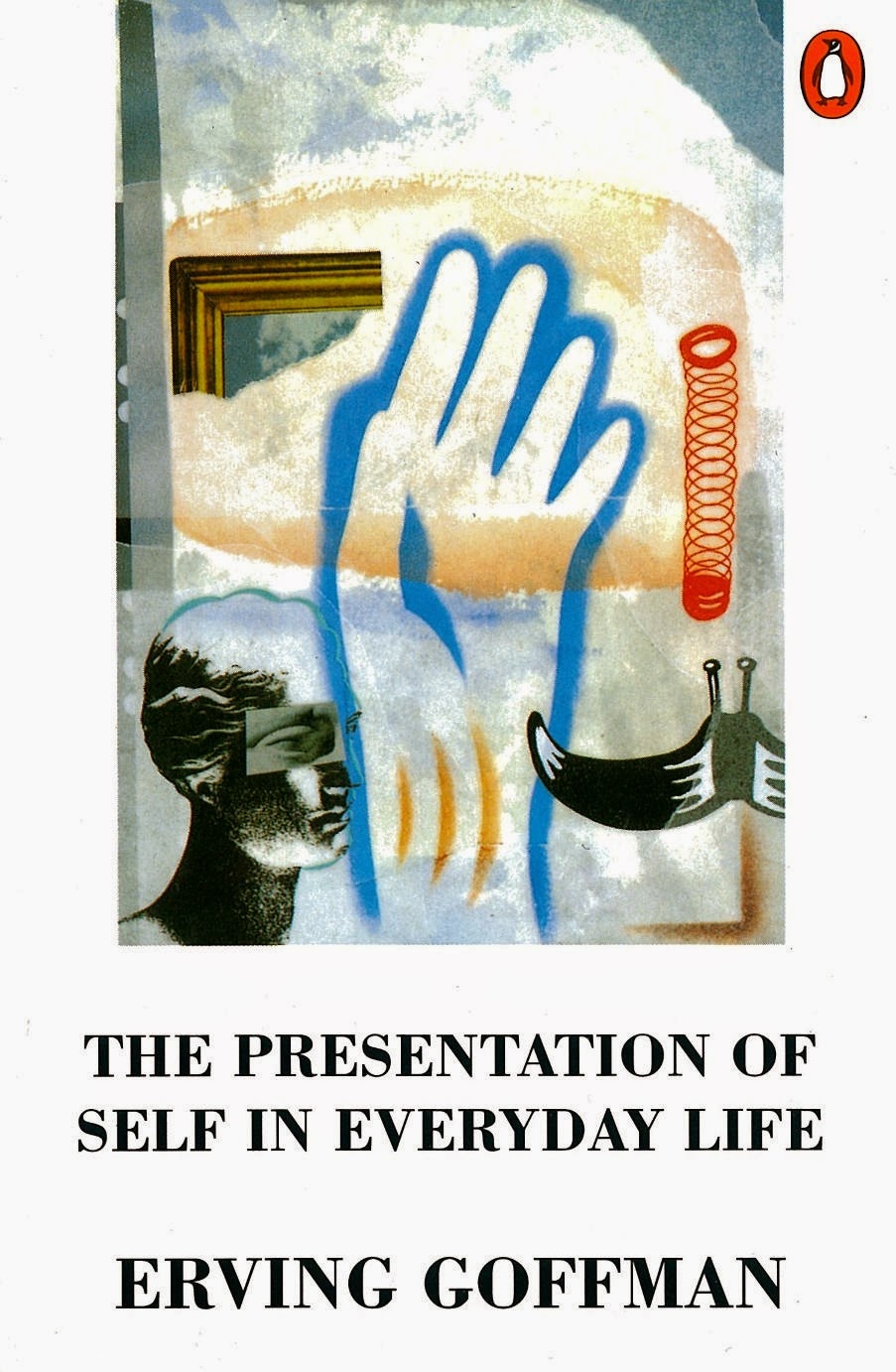
The Presentation of Self in Everyday Life, by Erving Goffman

Staff Review by Chris Saliba

In this classic study sociologist Erving Goffman shows everyday life to be more theatrical and ceremonial than we realise.

Erving Goffman (1922-1982) was a Canadian born sociologist and author. His 1959 book, The Presentation of Self in Everyday Life, is considered a classic in the field of sociology.  Goffman takes the novel approach of deconstructing everyday life into an elaborate theatrical performance. He uses the language of dramaturgy to describe how we interact with others, use props to denote status and behave like an audience member when watching individuals in the act of self-presentation. Goffman breaks down our everyday behaviour into its component parts and finds that we are more actors on the stage of life than we realise. He maintains that life is deeply ceremonial and highly artificial, especially in the way we keep society stratified into lower, middle and higher classes. “The world, in truth, is a wedding,” Goffman asserts. To illustrate his arguments, Goffman skillfully employs literary examples, from Simone de Beauvoir and Jean Paul Sartre to Franz Kafka and Evelyn Waugh.

This is a undoubtedly a work of high originality. Goffman makes his arguments convincingly. The way he dismantles everyday life into its separate parts and functions shows great psychological accuracy. It’s the sort of book that will make you see the world in a new way and make you examine your own social behaviour. If the book has a literary twin, it’s probably in the works of Jean Genet, especially his highly wrought play The Maids (1947), which examines masks, class, status and the fine line between the public and private persona. That play opens with two maids, Clare and Solange, impersonating their employer, Madame, in a ritualised murder fantasy. Another writer whose work somewhat resembles Goffman’s and examines social life as spectacle and performance is the English novelist E.F. Benson. In novels like Mapp and Lucia and Mrs Ames, society queens bolster their preeminent positions with the use of props, conspicuous display and careful concealment of unflattering personal information.

The only criticism that can be levelled at The Presentation of Self in Everyday Life is that the language is at times unwieldy and old fashioned. Some of his examples and discussion of sex roles are certainly outdated. The problem with the book’s language, however, may be that Goffman was trying to invent a vocabulary all of his own to describe his unique vision of society. Despite this, the book is well worth the effort and rewards with its originality and insight.

The Presentation of Self in Everyday Life, by Erving Goffman. Published by Penguin. ISBN: 9780140135718  RRP: $24.95

To sign up for our monthly newsletter, featuring new releases, book reviews and favourite articles from around the web, click here.

Wednesday, February 8, 2006

A Mind of Its Own: A Cultural History of the Penis, by David Friedman

The title of this book suggests it’s one of those novelty books that you buy as a gag for someone. The title, I presume, comes from Da Vinci’s ruminations that the penis behaves independently of its owner. An entire book devoted to the penis? This is a kind of interesting book, but not really a compelling read.

There were sections, like on the discovery of sperm, that I felt my eyes glazing over. Plus the long last chapter on Viagra and the goal of creating erections on demand I found a bit dull. If you had a scientific mind you might find these sections of interest. For me, I preferred the bits on Freud, Da Vinci and racism.

In short, I guess you might shout ‘sex’ to grab everyone’s attention, but once you talk about it for too long, and in such detail, it’s bound to get boring. Maybe pornographer Larry Flynt is right, the only way to get people’s minds off sex is to give them more than they could possibly want, then they’ll be begging off soon enough.

Here’s my quick chapter summary:

The Demon Rod.

This chapter describes the religious, mainly Christian view, of the penis as the work of the devil. Most witches often testified to having seen the devil’s penis – and what a whopper it usually was.

The Gear Shift

Da Vinci here rules the day. His scientific approach, cutting up bodies to find nature’s secrets, brings a breakthrough. Not air, or wind causes erections, but blood. Nice drawings too from Da Vinci, although he botched it slightly by drawing two tubes within the penis – one for urine, one for semen.

The Measuring Stick

This is all about the African penis. Is it the longest? The superior length of the coloured man’s penis was thought evidence, by the white man, of his moral depravity. African man was closer to animal than human. I liked how the author also took photographer Robert Mapplethorpe to task for his photographs of black men, saying he was no better than whites of a hundred years ago.

The Cigar

Freud and the penis. Perhaps enough said. He underwent a vasectomy because he believed it gave you a more potent sexuality. Nuts.

The Battering Ram

The second wave of feminism, and its opinion of the penis as a violent battering ram. You probably know enough about this too. Here are the key writers: Andrea Dworkin, Kate Millett, Betty Friedan, Germaine Greer, Shere Hite. Oh, and their arch nemesis, Normal Mailer. Remember the famous debate between Mailer and Greer? I wish we could get that on DVD.

The Puncture Proof Balloon.

Viagra, Viagra, Viagra. Apparently, scientists aren’t fully aware of the drug's possible side effects later down the track. Personally, I can’t think of anything more ridiculous than an old man, way past his prime, taking Viagra. Look at Hugh Heffner, in his seventies with all those young girlfriends. Well, I guess he seems happy enough.

Hmmm. This book kind of left me with an empty feeling. Don’t bother with it, unless you are penis obsessed. Read Freud and Da Vinci instead. And study the history of racism. Your time would be spent more profitably I think.