Showing posts with label Islam. Show all posts

Tuesday, August 8, 2017

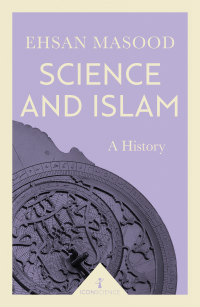
Science and Islam, by Ehsan Masood

Staff review by Chris Saliba

Ehsan Masood opens our eyes to the history of scientific achievement in the Islamic world.

A scientific tradition is not something we equate with Islam. London based science writer Ehsan Masood tries to rectify this error in his appealing history, Science and Islam. Covering roughly the period between the ninth and thirteenth centuries, Masood concentrates on what is considered an Islamic Golden Age. Islam produced a wealth of great thinkers in the sciences during this era: geographers, astronomers, physicians, engineers, pharmacologists, inventors, surgeons, mathematicians etc. The list is almost endless.

This Golden Age started under the Abbasid caliphate, when Islamic scholars energetically took to translating the great works of Greek and Roman thinkers. Coupled with this enthusiasm for translation was the mastering of paper production, learnt from the Chinese. This would have a huge impact on the spread of learning, as paper was so versatile.

One discipline where Islam truly excelled was medicine. Hospitals during the Golden Age employed physicians, surgeons and opthalmologists, as well as nurses, administrators and orderlies. Another area in which Islam excelled was astrology. The need to pray five times a day meant that there was always a strong interest in studying the slant of the sun and the position of the stars, so as to ascertain correct prayer times. Historians agree that eminent Islamic astrologers influenced Copernicus.

The most obvious influence of Islamic science on the world today is in the use of Arabic numerals. While what we call Arabic numerals were actually derived from India, it was the mathematician al-Khwarizmi who perfected the system we use for modern science and commerce. Key scientific words such as algebra, algorithm and alchemy are also Islamic in their provenance.

Science and Islam offers an accesible overview of some 500 years of Islamic thought and scientific endeavour. Ehsan Masoon writes in a beautiful lapidary prose, making his book a joy to read. The sections on great Islamic cities in their hey day, like Bagdad and Cairo, are a special treat for the reader who likes to time travel to exotic times and places. How magical Baghdad must have been in the ninth century, when it was the fabled city of The Thousand and One Arabian Nights.

A book that helpfully explains the rise of Islamic science, it unfortunate fall, and what needs to be done now to encourage scientific learning in the modern Islamic world.

To sign up for our monthly newsletter, featuring new releases, book reviews and favourite articles from around the web, click here.

Wednesday, November 4, 2009

Once Were Radicals: My years as a teenage Islamo-fascist, by Irfan Yusuf

Mr Yusuf is an Australian writer who frequently publishes opinion pieces in print and online media. I’ve always enjoyed his humourous slant on Islamic issues, so I thought I’d give his debut book a go.

A bit to my surprise, seeing the subject matter is growing up Muslim with Indo-Pakistani parents, I found this memoir to be a real page-turner. Before I knew it I was half way through the book, and by the time I got to the end I wanted a bit more.

For me one of the chief appeals of the book is the descriptions of the scholarly Islamic environment Irfan Yusuf was raised in. The descriptions of his educated, Urdu speaking mother are both endearing and funny. (Her anxieties centre around young Irfan doing well in his studies.)

The second half of the book describes the author becoming interested in political Islam. This leads him to make a few hasty conclusions about what it means to be a true Muslim. After much reading and soul searching, Yusuf rejects many of the tenets of political Islam. A lot of it he sees as enforcing monoculturalism and homogeneity.

Most non-Muslim Australians like myself see Islam through the lens of a hot and intemperate media. At the back of our minds, no matter how liberal we try to think ourselves, the media has created a mental template that equates Muslims with terrorism.

You should give this very enjoyable book a go as it will give you a more three dimensional, human picture of what it’s like to grow up Muslim.

Thursday, April 23, 2009

My Story, The Tale of a Terrorist Who Wasn’t, by Mamdouh Habib

Like most people, my impressions of Mamdouh Habib’s character have been formed by media and government commentary. One likes to think one has an open and independent mind, but unfortunately it’s not true. The question always arises, why did Mr Habib end up Guantanamo Bay? Surely, he must be bad. Or worse still, he must be a terrorist, and deserves all he got.

In many respects, I don’t think I’ve ever read a book like this. It’s completely surreal. Eerily, it has the ring of truth, like you’re reading the pages of Orwell, or Kafka or Dostoyevsky. For us regular citizens we’ve always seen these events through the prism of media and political spin. Mamdouh Habib takes us through that prism and to the other side. Many, many of the things described in this book are extraordinary.

The way Mr Habib describes it here, he was travelling in Pakistan and Afghanistan exploring business opportunities. He was having difficult times financially in Australia, and wanted to move his family out of the country if he could only find success else where. In Australia, he was being constantly approached by ASIO to work as a spy on the Muslim community. Because of this, many in the Muslim community suspected that Habib was in fact a spy, and this led to many problems.

Travelling around Pakistan and Afghanistan, Mr Habib was picked up by the notorious Pakistani Inter-Services Intelligence (ISI). He claims that agents from ASIO were present at certain interrogations, and that ASIO had known about his whereabouts in those countries. From then on it was all downhill. Habib claims that he was sold by the Pakistanis to the Americans (a common occurrence), and then taken to Egypt where he was tortured. Through Freedom of Information requests, Habib could later prove that DFAT and the PM’s office had known that he was taken to Egypt, even though this was at the time denied by the Howard government.

Much of the descriptions of torture in the book are like something straight out of George Orwell’s Nineteen Eighty-Four, and make for nightmare reading. The descriptions of ASIO, American intelligence agents and the Pakistani ISI are like a mixture of Gogol, Dostoyevsky and Kafka. They are frequently portrayed as being simply ridiculous, and living in a strange, degraded and deranged world of prejudice, stupidity and cruelty.

It is due to this that Habib’s memoir has the ring of truth. How could he create such an original, Orwellian world of torture? He even admits that all of his recollections may not be 100% accurate, but that he has never anywhere intentionally made anything up. Only a person struggling for the complete truth can make such an admission.

Mamdouh Habib:

‘Some people don’t seem to understand that, if you have been tortured continually for six months – and I don’t mean just being hit about a bit, but being severely tortured with electric shocks, burnt with cigarettes, threatened with drowning, hung from hooks and beaten, being deprived of sleep, suffering continual abuse and having a rod put in your rectum, as well as being drugged – it takes time for your mind to heal afterwards. '

He goes on to say that after such experiences that, ‘For a long while after, there is no firm reality.’

Also, he describes in detail tortures that are deeply humiliating, something that is extremely painful for him to do. It was these passages in the book that really made me feel for him, and think he is a brave and honourable fellow indeed for wanting to share this. To be so fundamentally reduced and humiliated, and then to describe it in the hope that it will stop it happening to others, shows courage.

Full marks must go to Julia Collingwood, Habib’s collaborator. She has done a wonderful job in providing a clear and lucid text. It’s a masterpiece of simplicity and good writing. Mr Habib should be very happy that he could bring out a book of such high literary quality.

It is early days for this case, and I’m sure more and more will come out as the years go by. The truth will certainly out, and we will one day know much more detail about what happened to Mamdouh Habib.

Last quote to Mamdouh Habib.

‘The world is full of terrors, and life is a nightmare.’

This is a nightmare book. It’s unbelievable that such things happen.

Thursday, January 17, 2008

People Like Us: How arrogance is dividing Islam and West, by Waleed Aly

Let me say from the outset that I thought this an absolutely terrific book and I’d urge anyone who comes across this review (or rave, rather) to give this book a whirl. Unbelieveably, the book wasn’t even Waleed Aly’s idea. Author Martin Flanagan talked Aly into writing it. What’s even more amazing about this book is Aly’s age: he’s only 29! (I know that’s probably a superficial point, but for a book that shows such depth, erudition and maturity, I’m frankly in shock.)

The most basic premise of this book is how poorly the West and Islam misunderstand each other. Aly sees himself as especially well positioned to discuss this issue as a Muslim who was raised in Australia. He has feet firmly placed in both cultures, and sees the argument that is played out before him frequently as some terrible farce.

What’s helping to compound this problem is the language we use. Aly quotes George Orwell to show that the language we now use in regards to this issue specifically limits the discussion. I couldn’t agree more with this sentiment.

Aly goes into a few key words and expressions to show how important the subtleties of language are. Arabic language and Islam are constantly translated into meaningless sound bites. (Aly also criticises the ‘Muslim world’ for the same thing.)

For example, the word jihad is frequently misunderstood. The word means ‘struggle’, and has a personal/spiritual dimension as well as a more military version. The former we are told is thought to be the more important in Islam. Of course all the subtleties of this word, its nuanced religious meanings, are flung out the window once it’s used by news broadcasters for shocking 6 o’clock news programs. I recall even Canberra press journalist Michelle Grattan using it to refer to inter party fighting amongst the Liberals. The word is thoroughly corrupted.

Aly also discusses the controversy over the wearing of the hijab, and the proposed banning of it. The author goes warily goes into the varying reasons that women like to cover their heads. I say warily because Aly notes that barely any hijab wearing women are ever asked why they wear it in the first place.

Even if you consider yourself a liberal minded Westerner on the issue of Islam, there is much in this book that may surprise you, as Aly breaks down the over simplified language we use in the West to describe Islam.

Some of the most interesting parts of the book describe Islam’s history and cultural contributions. When this is contrasted again Christianity’s history, Islam comes across as a modern, anti-hierarchical religion. As Aly notes, Islam simply doesn’t have an established church like Christianity does in the West. For example, there is no religious authority like the pope. Interpretation of the Koran is not so dogmatic as Christianity’s interpretation of the Bible. (Recall so-called fundamentalism, a modern phenomenon, began with Christian word-for-word readings of the Bible, what’s known as the inerrancy of the Biblical texts.)

As I mentioned earlier, there are many subtle and nuanced arguments in this absorbing book. When a young Western newsreader parrots the word jihad, mindlessly reading their teleprompter, what they are saying is virtually meaningless, meaningless to Islam anyway. What do they know of Islam’s 1400 year history, it’s culture, history, philosophy, beliefs etc? You know the answer.

Again, I urge anyone reading this blurb that they check out their library and give Waleed Aly’s book a go. He shows in equal measure the prejudices and delusions of the Islamic world, and the arrogance and ignorance of the Western world. His book is an admirable attempt to breach this huge gulf of understanding.

Saturday, May 13, 2006

Discovering Islam, by Akbar Ahmed

This is a nifty little book that covers Islam from its inception right up to its troubled times today. Akbar Ahmed has a pleasant, civilised style. Indeed, much of his project is to preach tolerance and understanding.

Interesting chapters highlight Western attitudes to the East, or what you would call in academic circles ‘Orientalism’.

The only down side is that the last few chapters come across as a little dated (the book was written in the late eighties). These chapters describe more current events in the Middle East, and have not been brought up to date.

This book makes for a friendly introduction to the culture and achievements of Islam.

(PS: I know this is a really short write up for this book, which may make it sound like it's not at all that substantial. Not at all. It's just that I don't know much about Islam. Nevertheless, I found this a very enjoyable read from a very cultured and humane author. Here is how I discovered him, on the ABC's Lateline program.)

Friday, September 9, 2005

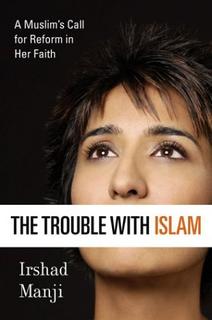
The Trouble With Islam, by Irshad Manji

Irshad Manji was born in Uganda, and at age of four migrated to Vancouver, British Colombia, in 1972. She’s lived in the West ever since, and much of her Western upbringing informs her attitude to Islam, or rather how she would like to see it reformed. This book is very pro-Western, and for the large part sees the answer to Islam’s current woes by adopting much of Western culture’s freedom of expression and free market ideology.

As a consequence, this book is highly polemical. Many will disagree vociferously with what Manji has to say. Especially with the way she lays blame not at the West, for its support of tyrannical Middle Eastern regimes, but rather with Islam itself.

One of the major themes of the book is what she calls ‘desert Islam’, that is, a belief that for Islam in any way to be valid or genuine it must be faithful, literally so, to the very historical beginnings of the faith. Imagine if all Christians wanted to live like Jesus’ contemporaries did. Even George W. Bush would baulk.

When Manji talks about laws for women in countries like Saudi Arabia, you can’t but agree. (Remember the recent case of two boys who were hung to death in Iran recently because they were homosexual.) The stoning of women? These aspects of Sharia law most in the West would find abhorrent.

There’s also a section in the book about Islam’s golden age of culture and achievement, between 750 and 1250. It was refreshing to read about when Islam was a world leader, a leading light in science and culture, making you realise Islam has not always been the Medieval religion it is perceived to be today.

I don’t know enough about Islam to give any kind of pointed opinion on this book. The author goes through a lot of Islam’s history (plus contemporary history), to point out where the faith has gone wrong. While she makes a lot of good points, a lot of points that can’t be refuted, I found she was too much of a cheer leader for the West. The way she dealt with problems seemed, to me, a bit too simple, too black and white. (At one point in the book she’s practically calling on Oprah to save Islam. One of her recipes to lift Islam out of the dark ages is to promote female entrepeneurs.)

Sometimes Manji also seemed to contradict herself. On the one hand she lauds to the skies the freedoms the West enjoys, then on the other hand she calls for less tolerance of Muslims (Muslims who transgress the law, or who are openly anti-social) in Western countries.

One thing that can’t be denied about her book though, it’s a very strong call for open discussion. Like a true democrat, she’s calling for free speech and open criticism of Islam, from all quarters. Despite her brassy – sometimes almost crass style – this should be commended.

Chris recommends you read this book. You might find yourself squirming in your seat sometimes, but if nothing else The Trouble With Islam is a breath of fresh air.