Staff review by Chris Saliba
An insider tells us what really happens behind the closed doors of global business and politics. Entertaining and revealing.
Have you ever wondered what happens at senior levels of government, business and bureaucracy? What type of intellect, temperament and personality it takes to make the important decisions that affects the lives of millions? In this revealing book, Swiss-American lawyer and economic advisor Daniel Levin spills the beans.
The truth, according to Levin, is not so pretty. The elite movers and shakers of the world are often vain, self-obsessed and greedy. Good policy, as a rule, takes a back seat to the personal whims, prejudices and fancies of politicians and businessmen. This is a world served by an army of courtiers, gatekeepers and flatterers, all intent on self-promotion. The institutions of politics and business exist within a bubble of meaningless rules, deference to authority and silly etiquette, all designed to keep a self-deluded elite in power.
Daniel Levin has worked across the globe, from Washington to the UN, from Russia to China. Levin also has a special interest in Africa, which has seen him working with governments there. In each of the interactions with officials from those countries and institutions, Levin describes zany and logic-defying behaviour, unless of course the logic is to maintain power. In Russia Levin finds it hard to pick the political allegiances of members of the Duma (Russia's parliament), so chameleon-like are their colours. Dealings with a Chinese business official goes awry when the official loses his temper, declaring that the Chinese are sick of being humiliated and will one day rule the world. A trip into The Gambia in West Africa is almost derailed, until Levin pays the required bribes. Working with elites in Washington and the UN is no better, staffed as they are by myopic, single-minded careerists.
What saves Nothing but a Circus from being a slash-your-wrists depressing read is Daniel Levin's gift for dialogue and explaining complex matters. He brings his rogue's gallery vividly to life, capturing accents, eccentric personalities and various comic scenes with brilliant economy. We can only hope his book will provide some kind of public service by giving readers an insight into how global institutions and governments are run.
Nothing but a Circus: Misadventures among the Powerful, by Daniel Levin. Published by Allen Lane. ISBN: 9780241299715 RRP: $35
(Released 30th January, 2017)
To sign up for our monthly newsletter, featuring new releases, book reviews and favourite articles from around the web, click here.
This blog started in 2004 as a diary of my reading habits and contains over 1300 reviews. As of 2018, I’ve combined other blogs I wrote into one. To see my current reviews, visit northmelbournebooks.com.au. This blog is maintained only intermittently.
Showing posts with label Politics. Show all posts
Wednesday, January 25, 2017
Thursday, January 14, 2016
Blood Year: Terror and the Islamic State: Quarterly Essay 58, by David Kilcullen
Staff review by Chris SalibaDavid Kilcullen explains the blunders of invading Iraq and Afghanistan, but offers no real solution to the problems they created.
David Kilcullen is a well known counterinsurgency specialist who has worked with such big names as General David Petraeus and Secretary of State, Condoleeza Rice. An Australian national, he has written several books. Currently he runs his own big data analytics firm which models conflict environments.
In this Quarterly Essay, Blood Year, Kilcullen gives an overview of the wars in Iraq and Afghanistan since 2001. As a key adviser on counterinsurgency strategy, he confesses that "we" got things wrong, but doesn’t really explain any advice he may have regretted giving. Hence it’s hard to figure out what kind of an impact Kilcullen has really had on war policy, from this essay anyway. The tone throughout is of someone trying to catch up with events, rather than being in the middle of them as they unfold.
What the reader learns is that, in Kilcullen’s opinion, the decision to invade Iraq was an enormous blunder. That blunder was compounded when the US took over Iraq and implemented a de-Baathification policy. This threw many police and military personnel out of work and paved the way for much bitterness. Eventually these sacked Iraqi military experts would join ISIS. President Obama didn’t do too much better when he took charge of the messes created in Iraq and Afghanistan. His desire to get out as quickly as possible was entirely unfeasible. An over reliance on drones showed weakness by taking the easier option, rather than sending in troops. In short, the invasion of Iraq pretty much created ISIS.
Kilcullen is quite candid in saying he doesn’t really know what the answer to this mess is. It’s something that can’t be unscrambled. However he maintains it is a new reality that Western governments must deal with. If we try to ignore the crisis, we will only have to face it at a later stage. He suggests that ISIS as it exists now can pretty much be considered a state and that it must be defeated as one. This calls for a much more aggressive military intervention, something he concedes would not be popular in Western electorates.
What this essay highlights is how the West is completely at a loss when it comes to dealing with ISIS. Kilcullen’s solution of a strong military intervention, of which even he remains unsure, is another roll of the dice. As in any war, its consequences, if implemented, would be impossible to anticipate. While there is much to recommend in this interesting essay, I’d heartily suggest reading British journalist Christina Lamb’s Farewell Kabul for a richer examination of the wars in Iraq and Afghanistan.
Blood Year: Terror and the Islamic State: Quarterly Essay 58, by David Kilcullen. Published by Black Inc. 9781863957328 RRP: $22.99
To sign up for our monthly newsletter, featuring new releases, book reviews and favourite articles from around the web, click here.
Thursday, July 4, 2013
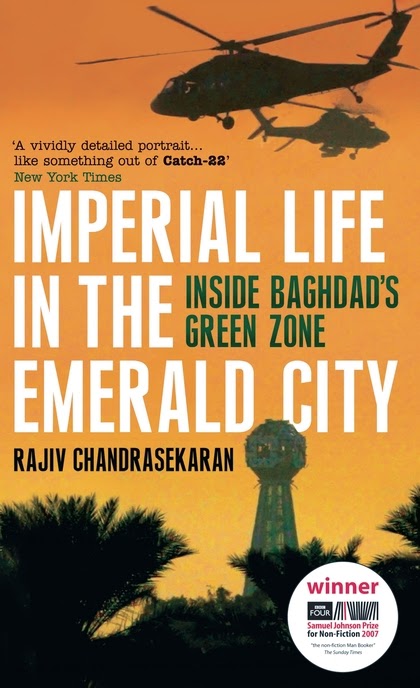
Imperial Life in the Emerald City, by Rajiv Chandrasekaran
Staff Review by Chris SalibaIn this compelling piece of on the ground journalism, Washington Post journalist Rajiv Chandrasekaran describes the chaotic and ill managed period of the Coalition Provisional Authority’s time in Iraq.
Imperial Life in the Emerald City details the actions of the Coalition Provisional Authority (CPA) in Iraq between the immediate post-invasion period and the handover of power to the Iraqis, with so-called insurgency attacks on the rise during that period. The CPA, headed by Paul Bremer, was run like a modern business enterprise. The whole 2003 – 2004 episode, as described by Washington Post journalist Rajiv Chandrasekaran, reads like an interesting example of what happens when technocratic thinking is applied to problems that require common sense and a firm grasp of reality. From the get-go, the CPA had big plans (dreams, really) of creating a fully functioning Western democracy in a matter of months. The Iraqi people were merely putty for the realisation of this grand scheme.
In fact, the Iraqi people were to all intents and purposes invisible to their occupiers. The list is long of CPA hot shots who took zero interest in Iraq’s history, culture, language and deeply damaged psyche. In many examples, it seemed as though the Americans thought of the Iraqis as standing in the way of their elevated vision for a Middle Eastern democracy. The recruitment process for getting on the CPA payroll required an enthusiastic belief in the ideals and political aims of George W. Bush. People with few qualifications could find themselves fast tracked into plum jobs in Iraq if they were connected in some way to key Republican Party figures. Those with appropriate skill sets were often sent back for not being simpatico enough with the overall Bush program. It was a case of not what you know, but who you know.
Chandrasekaran writes in a pithy and fast paced manner. He works a large amount of material into a cracking tale of good intentions turned into a terrible farce. He reports from on the ground in Iraq and the Green Zone, giving his writing a feeling of great immediacy. Imperial Life in the Emerald City almost reads like a novel, with absurdist scenes involving government officials and contractors creating mayhem but patting themselves on the back for a job well done. This is a tale of bureaucracy gone mad. George W. Bush convinced a hoard of fellow believers in a form of magic thinking. He thought he could invade Iraq, raze half of it to the ground, and build it up again in a couple of months as a glittering democratic jewel in the Middle East.
Imperial Life in the Imperial City is a both a cautionary tale, the anatomy of a train wreck and an example of what happens when political dreams backed up by awesome military power crash against reality.
Imperial Life in the Imperial City, by Rajiv Chandrasekaran. Published by Bloomsbury. ISBN: 9780747592891 RRP: $24.95
Tuesday, January 17, 2006
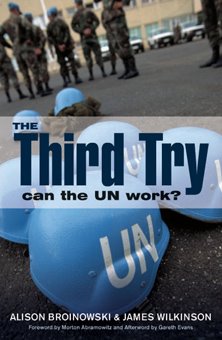
The Third Try: Can the UN work?, by Alison Broinowski and James Wilkinson
It may surprise the reader to know that a majority of Americans support a stronger United Nations, believe in international co-operation, favour spending money to help out poorer nations and even support the International Criminal Court (ICC). All this despite the current Bush administration’s pronounced displeasure with the UN.In an effort to undermine the legitimacy of the UN, US Congress has withheld UN dues, rejected multi-lateral treaties and under funded foreign-aid programs. To state the Bush administration’s case most clearly, there was the nomination of John (‘There is no such thing as the United Nations’) Bolton as US permanent representative to the UN, whose antipathy to the organisation is well known.
At home, the UN is in bad odour with the Australian Government. After receiving a bad report card on our treatment of migrants, Muslims, asylum-seekers, refugees and Aborigines, John Howard reminded all that ‘Australian laws are made by Australian parliaments elected by the Australian people, not by UN committees.’ Alexander Downer (http://www.abc.net.au/7.30/stories/s115193.htm) went one step further: ‘If a United Nations committee wants to play domestic politics here in Australia, then it will end up with a bloody nose.’
Alison Broinowski and James Wilkinson are both experienced diplomats, bringing their respective Australian and American perspectives to a broad and complex subject. The authors claim the UN has been through two ‘tries’, or stages, already.
The first try at a world order was the League of Nations, established after World War I in Geneva, Switzerland in 1920. The second was the United Nations, which was given birth on 24 October 1945, when the UN Charter was ratified by a majority of signatory nations. The third try, where we are now, the authors argue is the post-Cold War era. After September 11, can the UN work?
The Third Try doesn’t flinch when discussing the UN’s many failures, some of them horrific. On Rwanda, the authors write ‘There was no excuse for the council’s failure to intervene over a period of about three months while the killings continued apace.’
Then there was the scandals involving peacekeepers in the Democratic Republic of the Congo, including sexual abuse of people the UN was supposed to be protecting:
‘The secretary-general in November 2004 publicly acknowledged gross sexual misconduct by MONUC staff and vowed a ‘zero tolerance’ policy with punishment for all found guilty. Over 150 cases of alleged rape and exploitation, involving both military and civilian staff and including abuse of girls as young as 12, were under investigation at the end of 2004.’
Darfur is the latest example of the UN’s inability to respond adequately to an urgent crisis. By the end of 2005 some 1.7 million people were homeless and 70,000 people were estimated to have died from the conflict. The authors write:
‘The Security-Council’s inquiry on Darfur took three months and then delivered an ambivalent report, calling what was happening crimes against humanity and the equal of genocide, but not describing it as genocide in the narrow, post-World War II definition that required proof of intent to destroy a population or group.’
Despite the above, and other examples cited, the authors maintain the UN will continue on. Simply put, it does too much. There are the peacekeeping operations, work to reduce poverty, counter terrorism initiatives, bolstering of international law through the ICC, human rights advocacy, help for refugees and so on and so forth.
It is also worth remembering that, despite the Bush administration’s contempt for the UN, it did not stop them asking the organisation for help to rebuild post-war Iraq.
As the authors state:
‘No serious argument can be made for doing away with the UN entirely. As our review has shown, it serves too many purposes, practical as well as noble. The neo-cons’ black prince, Richard Perle, even while thanking God for the death of the UN, conceded that its ‘good works’ part will continue to endure.’
The problem then is how to improve it and make it work. Broinowski and Wilkinson devote some 40 pages to analysing problems in the UN machinery and bureaucracy, recommending repairs and reforms. At the top of the list is a need for the US to play a more supportive role, rather than that of a wrecking ball.
‘The perpetual disdain of American conservatives for the UN casts a dark shadow over all parts of the UN, and Washington’s aggressive disputation with the UN over policy, resources, and decision-making has become progressively more imperious since the 1980s.’
The Third Try is written for the lay reader and is set out in a clear, straightforward style. The book doesn’t cover everything that the UN does, but rather works as a digest of its key roles. Its accessible manner makes welcome reading when facing such a daunting subject.
For citizens interested in working towards an international system to solve world problems, The Third Try is an excellent primer on the UN. Bonus features include a forward by Morton Abramowitz, a former president of the Carnegie Endowment for International Peace, and an afterword by Gareth Evans, who now works as the president and chief executive officer of the Brussels-based global conflict prevention organisation International Crisis Group.
Saturday, December 31, 2005
Idiot Proof, by Francis Wheen
This book is subtitled ‘Deluded Celebrities, Irrational Power Brokers, Media Morons and the Erosion of Common Sense’. Actually, I think the copy I have must be an American edition, as the page of publishing details says it was first published in Great Britain under the title of How Mumbo Jumbo Conquered the World: A Short History of Modern Delusions.I heard Francis Wheen interviewed on ABC radio, and he was talking about how much he loved the classic by Charles Mackay Extraordinary Popular Delusions and the Madness of Crowds. I got the impression that he wanted to write up his own contemporary version, hence the use of the word delusions in his original title (I wonder why it was changed for the Americans?)
Francis Wheen is one of those writers who is just a tad supercilious; he reminds me of those preternaturally smart kids at school, who knew every subject off hand before even being taught it. When interviewed on ABC radio he was asked if he was just a bit of a snob, going after all these popular fads, and the poor guy was a bit lost for words, and didn’t really answer the question. While there is a faint whiff of snobbery about Francis Wheen (not that I mind, I like a good dose of snobbery myself), this book is more serious than that.
Wheen starts his survey of the delusions of modern civilisation with the rise of Margaret Thatcher in England and the return of the Ayatollah Khomeini to Iran. In short, a criticism of free market ideology and fundamentalist religious creeds. That is one of the good things about this book, he takes pot shots at not just one side of politics and cultural thought, in this case the right, but goes right after the fundamentalist beliefs and philosophies of the left. No one is left out. Wheen even has a go at the likes of John Pilger and Noam Chomsky.
The aim of the book is an attempt to restore common sense in a world where we are being by the nose by the likes of Deepak Chopra and other spin merchants. Fat chance I say. (The part of the book which describes Tony and Cherie Blair’s re-birthing ceremony will blow your mind! The fact that Ronald Reagan’s travel plans had to get clearance from Nancy’s astrologer will – well, I don’t know what effect it will have on you. I can’t even digest information like this myself. It won’t go down).
This is a book for that minority of the public who prefer rational to magical thinking.
Web Experience Links by Francis Wheen:
Hoo-Hahs and Passing Frenzies
Who Was Dr. Charlotte Bach?
Subscribe to:
Posts (Atom)