Showing posts with label John Fante. Show all posts

Monday, May 15, 2017

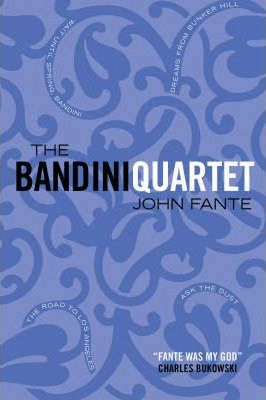
The Bandini Quartet, by John Fante

Staff review by Chris Saliba

John Fante’s cycle of four novels set during the Great Depression.

The Bandini Quartet comprises four novels by American-Italian writer John Fante, based on the autobiographical character Arturo Bandini. The first three of the novels were written during the 1930s (The Road to Los Angeles was published posthumously, found amongst John Fante's papers.) The final novel, Dreams From Bunker Hill, was dictated to Fante's wife, Joyce, as he was blind with diabetes.

Written in a clean, crisp, unadorned style, frequently shot through with humour and sharp dialogue, the novels have much to say about poverty, being Italian and America during the Depression. More than that, they provide a striking portrait of an aspiring artist and outsider trying to prove their worth in an often crude and cruel society. They are a study of the self in isolation. No other cycle of novels is tinged with so much loneliness and vulnerability, without being mawkish or sentimental. Fante's language is so immediate and clear-sighted The Bandini Quartet reads like it was written only yesterday.

Wait Until Spring, Bandini

First published in 1938, Wait Until Spring, Bandini introduces Arturo Bandini, aged thirteen. He has two younger siblings, Frederico and August. His father, Svevo, is a bricklayer and stone cutter, struggling to make enough to keep his family fed with a roof over their heads. Maria, Arturo's mother, is a strongly religious woman. She is frequently mistreated by a husband who feels his life to be a humiliation.

There is much humour in Wait Until Spring, Bandini, especially the descriptions of Maria's mother, the ogre-like Donna Toscana. Her relentless criticisms of Maria's household and circumstances, mixed with her own grotesque appearance, makes for a brilliant, Rabelaisian comic portrait.

The novel ends on a note of pathos. Arturo is in love with fellow classmate, Rosa Pinelli, but is too shy and unsure of himself to express his admiration.

The Road to Los Angeles

Arturo Bandini is eighteen-years-old and living at home with his mother and sixteen-year-old sister Mona. (There's no mention of male siblings in this novel.) He now considers himself a writer and dreams of being famous.

The tone is of a flippant and confident Arturo. He is a mercurial character and speaks in a grandiloquent, over the top voice as he dreams out loud of his assured greatness as a novelist. The reality, however, is that he must work a dirty job at a seafood cannery. (The sections that deal with the cannery are some of the best and funniest in the novel.)

This is the story of a young working class man with dim prospects, trying to survive during the Great Depression.

How sad that this fine novel was not published during Fante's lifetime.

Ask the Dust

Arturo Bandini is now a twenty-year-old writer, living by himself in the seedy Bunker Hill area of Los Angeles. He ekes out a meagre existence in a dingy hotel. His only claim to fame is the publication of a short story, “The Little Dog Laughed”, in a magazine. Despite his straitened circumstances in depression era America, Bandini is exultant, for he believes he is on the cusp of great literary fame.

Much of the comedy in Ask the Dusk derives from Bandini's delusions of grandeur. He's surrounded by squalor, filth, poverty and misery, yet he speaks in exalted and flowery language about his greatness as a writer. Those around him don't see him this way. When he tries to give away copies of the magazine in which his story has appeared, no one is interested. The only person who takes him seriously as a writer is a fourteen-year-old girl who wanders into his hotel room.

Ask the Dust feels like it prefigures much classic American literature. The mental collapse of the waitress Camilla Lopez reminds one of Sylvia Plath's The Bell Jar, as does Fante's simple, poetic language.

Dreams from Bunker Hill

The last Bandini novel, written when Fante was blind with diabetes. He dictated it to his wife, Joyce, during the early 1980s. The novel is pretty much a sequel to Ask the Dust. Bandini is still trying to make it as a writer in Los Angeles. He gets a job as an editor which is short lived. He then works as a screenwriter and meets various interesting film industry characters. The portrait of fellow hack screenwriter Velda van der Zee is a special stand-out. She can't stop dropping names about who she's met and writes terribly cliched screenplays.

Sick of his struggles trying to make it in Los Angeles, Bandini returns to his family's home in Boulder, Colorado. He boasts to his family and friends about this exploits, lies really, that he's a big shot. But once again he's restless. He knows he doesn't fit in, either in Colorado or Los Angeles. What to do? Where to go?

The Bandini Quartet, by John Fante. Published by Canongate. ISBN: 9781841954974 RRP: $29.99

To sign up for our monthly newsletter, featuring new releases, book reviews and favourite articles from around the web, click here.

Thursday, February 20, 2014

1933 Was a Bad Year

Staff Review by Chris Saliba

John Fante's posthumously published novella, 1933 Was a Bad Year, is a funny yet sad story about the great gulf between reality and illusion, between the poverty of the Great Depression and the impossibly high hopes of the American dream.

Since reading John Fante's The Brotherhood of the Grape (1977), I've become an absolutely devoted fan of this American great. The only pitfall of hero worship is that, sooner or later, you're sure to come across something that fails your high expectations. So far, however, so good. Having just finished 1933 Was a Bad Year, I can report another brilliant read.

Everything I've read by Fante so far follows a similar path. In fact, his books seem to concentrate on the same main characters over and over again: his father, his mother and siblings. Fante's fiction is one obsessive quest to make sense of his personal family history. It's his honesty and vulnerability that makes reading him such a cathartic experience.

1933 Was a Bad Year is a short novel at 127 pages, published posthumously. It tells the story of Italian-American Dominc Molise and his deluded belief that he is destined to be a great baseball star. The reality is quite different. His family is poor, his father is deep in debt and his mother is a long suffering wife to her unfaithful husband. For comic relief Dominic also lives with his blunt and opinionated Italian grandmother.

Dominic is a 17-years-old and going through all the usual teenage problems. He's in love / lust with his best friend's sister, Dorothy. When the two get together on a sort-of date, she does a bit of amateur psychoanalysis on Dominic. Her breezy manner and clear indifference to him makes for many hilarious scenes.

In an attempt to get to California to fulfill his dreams, Dominic does a shameful thing. Realising the error of his ways, he tries to make amends, and things are resolved in a rather messy and unsatisfactory way. Grand American dreams of success, fame and money are only there to mock the poor who grind away in poverty. Dominic and his family remain humiliated and stuck in a hopeless cycle.

This is a funny, sweet and honest short novel that reads like a perfect little slice of American life. It seems extraordinary that it was published posthumously. I don't know how well John Fante is read in America, but it seems a shame more people don't know about him in Australia. He's almost a literary little brother to such classics as Sylvia Plath's The Bell Jar and J. D. Salinger's Catcher in the Rye.

1933 Was A Bad Year, by John Fante. Published by Black Sparrow Press. ISBN:  9780876856550 $19.95

Tuesday, January 14, 2014

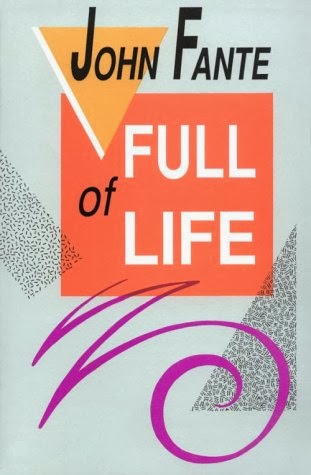
Full of Life, by John Fante

Staff Review by Chris Saliba

John Fante's 1952 autobiographical novel Full of Life is a minor gem, a slice of Italian-American family life set in 50s America. It's funny, poignant and rings true to life.

Recently chance brought to me a wonderful book by John Fante called The Brotherhood of the Grape (1977). John Fante was an Italian American novelist publishing mainly between the 1930s and 1950s. He was also a huge influence on Charles Bukowski.  Hoping to repeat my happy experience with The Brotherhood of the Grape, I purchased a copy of his 1952 novel Full of Life. (Fante also wrote the screenplay for the 1957 film version.)

Like Fante’s other novels, Full of Life is entirely autobiographical. Written in the first person, the narrator is even named John Fante. The story basically centres around Fante’s pregnant wife, hence the title. John is struggling  to deal with his wife’s condition. Other dramas are thrown in when his mad Italian-American father and mother enter the scene and throw everything haywire. They are both superstitious Italian immigrants with their own totally irrational ideas. Fante paints them as loveable yet impossible. These parental portraits are often very funny, although Fante never ridicules. He rather teases out all the complexities and contradictions that come with close human relationships. In the end the reader gets a neatly drawn picture of life within an Italian American family in 50s America.

This is another perfect little gem of a book. Fante’s scope is small: his literary world only consists of his immigrant parents and 50s suburban life. But the execution is absolutely faultless. He captures the language and situations of the times in a neat, tidy prose that is unpretentious and honest. It’s a mystery that Fante is not better known amongst such American greats as Nathaniel West, Sylvia Plath, John Cheever, J.D Salinger and Richard Yates.

Full of Life, by John Fante. Published by Black Sparrow Press. ISBN: 9780876857182  $19.95

Tuesday, December 3, 2013

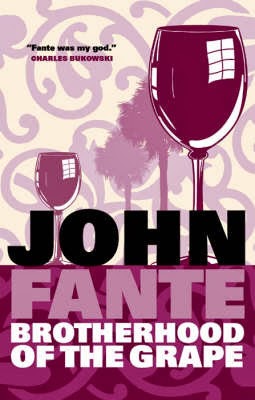
The Brotherhood of the Grape, by John Fante

Staff Review by Chris Saliba

If you enjoy the comedy and pathos of writers like Charles Bukowski and David Sedaris, then this perfect short novel by John Fante about a squabbling family and its tyrannical father is sure to please.

Many years ago I read John Fante’s best known and loved book, Ask the Dust (1939). I enjoyed it, but wasn’t bowled over, and thought that it would be my first and last Fante novel. Then when I started reading Charles Bukowski, I learnt that he was a huge Fante fan. This raised my interest a little bit. Then recently, just by luck, a copy of his 1977 novel The Brotherhood of the Grape, came into my possession. (Interestingly, this seemed to be his first work after 25 year absence from publishing.) Well, I was totally won over from the very first page to the last and am looking to read other Fante novels.

The brilliance of this novel is its simple, clean language and vibrant portraits. All the characters are so real they simply leap off the page. You quickly find yourself building emotional relationships with  the novel’s wild cast. They’re all nuts, some terrible, but despite this you care and want to find out what happens to them. Fante concentrates on what’s true and strips everything else away. He’s also wonderfully funny. The comic scenes and dialogue are polished gems. What’s interesting in Fante’s writing is that he writes The Brotherhood of the Grape from an autobiographical perspective, the narrator being a mildly successful novelist, yet Fante manages to achieve balance and perspective.

Like all great works of literature, The Brotherhood of the Grape is at heart a family drama. Henry Molise, the narrator, learns from his brother Mario that his parents are planning to separate after five decades of marriage. It’s all ridiculous, of course, but the siblings must band together to try and get the parents back together. Making this task a nightmare is Henry’s incredibly cantankerous and pig-headed father, Nick Molise. Another toxic ingredient is the fractious relationship of the siblings themselves. None of them get along. Things go from bad to worse when Nick insists his son go away with him to do a job creating a smokehouse for a friend. (Nick is a stonemason.) Against his better judgement, and under some pressure from his mother, Henry agrees. Events take a dramatic turn when Nick’s health problems catch up with him and he winds up in hospital.

The Brothers Karamazov (Henry Molise is a big Dostoyevsky fan) this novel is not, but I’d give it a 10 out of 10 anyway. It’s a perfect little gem that breathes real life on every page. You greedily read it as though your life depended on it. Fante strives to give as accurate a portrait of life as he can. The result is an aesthetic experience that works like a balm for the soul. I envy anyone who’s about to pick up The Brotherhood of the Grape and enjoy it for the first time..

The Brotherhood of the Grape, by John Fante. Published by Canongate. ISBN: 9781841956190  RRP: $19.99