Showing posts with label Nassim Nicholas Taleb. Show all posts

Wednesday, February 13, 2013

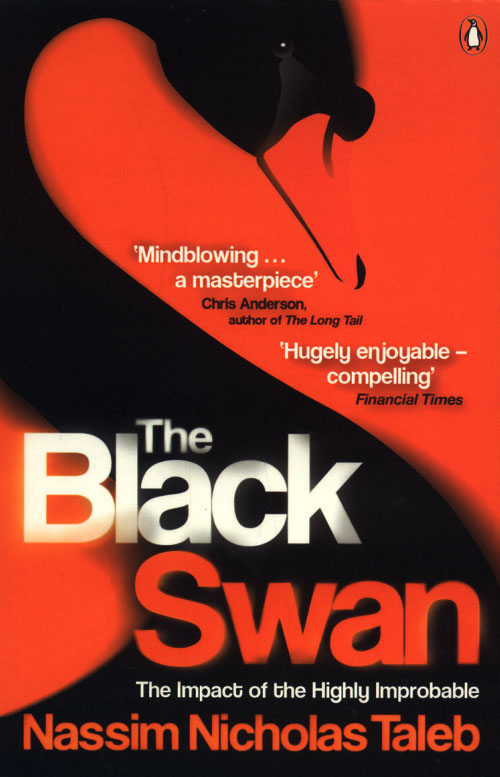
The Black Swan, by Nassim Nicholas Taleb


Staff Review by Chris Saliba

In Nassim Nicholas Taleb’s modern classic the philosopher-trader warns that the world is full of unpredictability, despite so called experts and their inclination to distil life into easily managed statistical models and optimistic bell curves. 

Perhaps the quickest way to summarise the basic premise behind The Black Swan is the well-known saying attributed to Socrates: I know one thing, and that’s that I know nothing. The term ‘black swan’ actually refers to the once common belief that black swans didn’t exist, until of course they were discovered in Australia. Prior to that, a common expression for something that was deemed impossible was to call it a ‘black swan’. The lesson to be drawn is not so much to expect the unexpected, but rather to not categorically rule it out.

Taleb’s book is of course more nuanced than that, and he teases out the notion of outliers or unexpected events in fine detail. He warns that complicated societies are more prone to black swans, that is, completely unpredictable events. This would be fine if as a society we were prepared to accept uncertainty, but the opposite is the case. We rely on too many experts and professionals (both in business and government) that think they have the power to model the future upon predictable lines. Taleb is at his most trenchant when criticising these technocrats and heroes of the business world.

The reason we slip into this mode of thinking is because it is appealing to create statistically cheerful models based on positive events that happened in the past. We believe that if the economy has been good in the last six months, it will continue to be good indefinitely. No one ever sees a crash coming during the good times. Hence what happened yesterday is not necessarily a good predictor of what will happen tomorrow. Writ large, this means societies are planned with blinkers on, not taking into account outliers or unknown events. We think inside a cosy bubble, fooling ourselves that we are omniscient, blinding ourselves to the very notion of surprise events. When these ‘black swans’ do hit, no one is prepared for them.

On the flipside, there are also positive black swans, like a bestseller book that was rejected by all major publishers then published by the author at their own expense. My own example came to me when watching (briefly, I’m no big fan) a documentary on the English band Queen. The song ‘Another One Bites the Dust’ barely made it onto their album Play the Game. The band’s drummer even hated the song and didn’t want it released as a single. No one ever thought it would be a single, let alone a hit. But at the urging of Michael Jackson (a friend of Freddie Mercury) it was released and went on to become a monster hit. No one saw it coming (except of course for Michael Jackson): a positive black swan!

Another main theme of the book is how we like to create a narrative out of random events. For example, we think the CEO got to his or her position through hard work and intelligence. Taleb begs to differ, and says luck has a lot more to do with it. We like to read history as following a rational, straight line. Taleb says history is messy, with major events happening in fits and starts. Our brains are hard wired to search out meaningful stories in the randomness that is everyday life.

What’s the take-away? Taleb styles himself part philosopher and part real world practitioner (he worked as a trader). His book calls on us to accept that the world is full of unpredictability. The experts and technocrats with all their models, statistics and bell curves think they can safely map out the future and eliminate risk. Taleb says Baloney! The truly brave person is the one who can admit that they don’t know.

The Black Swan: The Impact of the Highly Improbably, by Nassim Nicholas Taleb. Published by Penguin. ISBN: 9780141034591 RRP: $26.95

Monday, January 7, 2013

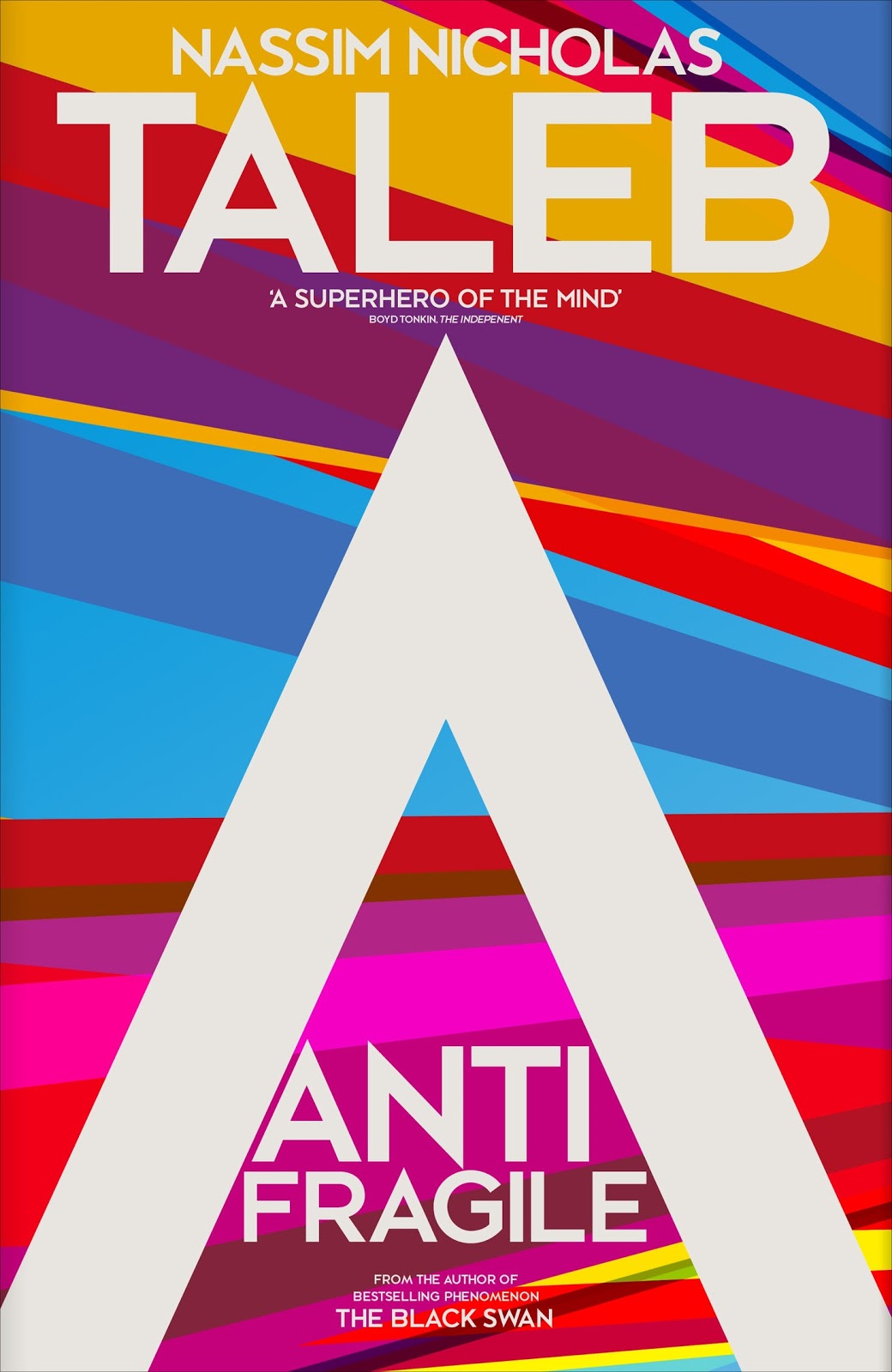
Antifragile: Things That Gain from Disorder, by Nassim Nicholas Taleb

Staff Review by Chris Saliba

Nassim Nicholas Taleb’s Antifragile argues that mistakes, setbacks and misfortunes can be good things if we learn to profit by them. In this ultimately positive and life affirming book, experience is championed over theory, risk over safety.

This is a vibrant and contentious book that is hard to categorise. It purports to pioneer new intellectual territory, but is really a series of energetic and impassioned riffs on old ideas. Indeed, Taleb is forever referring back to the great thinkers of antiquity, the Greeks and Romans. This is not to say that Antifragile is stale and unimaginative. Anything but! The book’s chief attraction is the freshness and robust vitality of Taleb’s writing that bursts from every page. Right from the get-go it’s clear that he doesn’t give a fig if people take him seriously or not. His prose is full of personal jokes and idiosyncrasies of style. He mixes erudition and buffoonery in equal measure, like some of the clownish characters in Dostoyevsky and Shakespeare. At times his sheer outrageousness approximates the writings of Salvador Dali, and yet there is a deep vein of common sense behind everything he says.

The basic premise of Antifragile can perhaps be summed up in the famous saying of Nietzsche: That which does not kill me only makes me stronger. Taleb maintains that people often confuse the opposite of fragile as robustness. This is wrong, we are told. The robust only resists shocks and stressors. But the ‘antifragile’ actually bounces back even stronger. Thus we travel from the fragile to the robust and finally to the ‘antifragile’. This new word, ‘antifragile’, Taleb claims as his gift to the English language. He seems certain that it will catch on and soon establish itself. It seems doubtful, but stranger things have happened.

Nietzsche’s famous saying is not the only concept that gets a reworking. The book is full of old saws and maxims modernised and updated into a ‘new’ philosophy for the 21st century. Taleb is upfront about wanting to rehabilitate the sayings and wisdom of our grandmothers. Any idea or technology, he says, that has stood the test of time has an innate truth that we would do well to pay attention to. For example, arguing against the e-reader, Taleb tells us that he has had the honour of reading a 500-year-old book, and that it was very similar to reading its modern day version. Ironically, he has word documents that have been superseded by new technology, and can’t now be opened.

In many ways this is a robustly conservative book. Not in any modern political sense of the world, but rather in Taleb’s reverence of the great writers of antiquity and his faith in ideas that have passed the test of time. This is a book that holds intellectual fads and modern day’s proliferation of opinion over lived experience in deep disdain. Taleb is constantly dismissive of those he thinks of as mere theorists as opposed to ‘doers’. Those who theorise and promulgate their ideas, but take no risks, are held in deep contempt. The worst example of this is Thomas Friedman, who spruiked for a war in Iraq, but didn’t have to take any personal risks.

Taleb has an amusing expression for the Thomas Friedmans of this world: ‘fragilistas’, meaning leaders and decision-makers who are protected from risk. These are the people in government, business and the media who implement or promote their theories and ideologies, but take no risks. CEOs can drive companies into the ground, but still get remunerated handsomely. Politicians can launch wars, but don’t have to fight. Media practitioners like Thomas Friedman can play advocate of any sort of dangerous policy because they stand to lose nothing.

Modern life is too large, complex and impersonal, according to Taleb, and hence deeply fragile. The huge bureaucracies and businesses that run our modern lives could easily crumble at the slightest knock: a computer glitch and all civilisation comes to a halt. The only way to protect ourselves is to reduce and simplify our government and economic structures, accept the consequences of risk taking and learn from mistakes to make improvements.

Antifragile is an unusual and ungainly title. A more accurate description would be ‘The Book of Reality”. It advocates small business, home cooking, local living, calculated risk taking and making mistakes as a necessary part of life. It also honours personal sacrifice for others over personal advancement. The book’s heroes are the many silent failures of history who put their ideas on the line and made personal sacrifices. They are the doers, those who try but fail. This enables others to consequently learn and eventually succeed.

This is an enormously satisfying book. You may wrestle with a lot of its ideas and often find yourself flustered in disagreement. Its style is busy, bossy, argumentative, blunt, humourous and entertaining. Taleb really engages the reader as an intellectual equal (he even thanks the reader for reading his book on the last page). It’s like sitting across the table with an impassioned interlocutor who shakes you down for your every opinion. But unlike any other modern book of non-fiction, this one is genuinely life affirming. I felt happier having read it.

Antifragile: Things That Gain from Disorder, by Nassim Nicholas Taleb. Published by Penguin. ISBN:
9781846141577  RRP: $29.99