Showing posts with label Philip K. Dick. Show all posts

Thursday, April 14, 2016

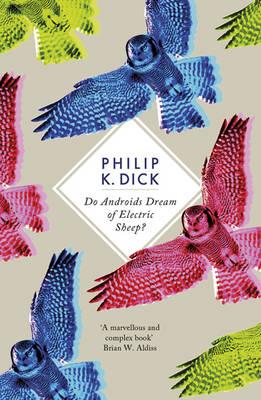
Do Androids Dream of Electric Sheep? by Philip K. Dick


Staff review by Chris Saliba

Philip K. Dick's classic novel explores what it is to be human in a world of advanced technology. 

Rick Deckard is a bounty hunter, his job to kill (“retire”) androids. He is given a challenging task to perform: kill six Nexus-6 androids. These are androids that are more intelligent than most humans. They have escaped from Mars, where they worked as servants to humans. To verify whether someone is an android or not, Rick Deckard must administer a test that checks for a person's empathy levels, as this is the only thing that differentiates a human from an android. Much of the novel's superb meditation on personality is seen through this prism of human empathy. In one chilling scene, one of the androids cooly snips the legs off a spider. One of the subtle lessons we learn is that technology dehumanises without us knowing it.

Meanwhile, in a run down, empty apartment building lives a “special” named John Isidore. Specials are on the lowest rung of society, derisively called chicken heads. Isidore is not highly evolved intellectually, but he is deeply empathetic, and longs for company. When he befriends the Nexus-6 androids that have escaped, his simplicity leads him to develop feelings of empathy for them, even though they are cold and manipulative. Part of John Isidore's tragedy is that real friendship with these androids is impossible.

Another main part of the plot involves Rick Deckard's desire to obtain a real animal. To own one confers status, because to own animals shows your empathetic qualities. Rick owns an electric sheep. Seeing most of the animals on planet earth have died off after a nuclear war, they are quite difficult to come by, and hence quite costly. One reason why Rick wants to make a lot of money from bounty hunting is so he can buy his own animal, a real one rather than a fake one.

It's hard to encapsulate this extraordinarily imaginative and emotionally deep novel. The themes it deals with are profoundly existential: the nature of being, our relation to the animal world, the common need for religious feeling, technology and its power to change and dehumanise us. Do Androids Dream of Electric Sheep? is a visionary work of literature. While on the surface its a sci-fi story, underneath it bores into the reader's consciousness with its relentless existential and philosophical questions.

Do Androids Dream of Electric Sheep? by Philip K. Dick. Published by Phoenix. ISBN:  9781780220383 RRP: $19.99 

To sign up for our monthly newsletter, featuring new releases, book reviews and favourite articles from around the web, click here.

Monday, January 18, 2016

Nick and the Glimmung, by Philip K. Dick

Staff review by Chris Saliba 


Philip K. Dick's only novel for children, Nick and the Glimmung, is a fine adventure full of mystery, wonderful characters and strange events.   


Science fiction master Philip K. Dick wrote one book for children, Nick and the Glimmung. Originally composed in 1966, it was rejected when submitted to the publishers, Doubleday. The manuscript was thus put in a drawer and didn’t see the light of day again until the author’s death in 1982. It was first published by Gollancz in 1988. Reading it today, fifty years after it was first written, it has the quality of a timeless classic.

It is 1992 and planet earth is crowded. Jobs are scarce, as are resources. To conserve food for humans, all pet ownership is now illegal. Nick, a young boy, has a cat named Horace. Somehow the authorities have found out. The ‘anti-pet man’, an overly militaristic looking police officer, has turned up at Nick and his family’s house. He aims to get rid of the cat. The only option is for the entire family - Nick, his parents and Horace the cat - to leave planet earth and settle on a new colony, Plowman’s Planet.

Once they arrive on Plowman's Planet, all sorts of strange things start to happen. They meet the local indigenous creatures - a lazy wub, the vulture-like werjes and the rather funny spiddles, amongst many others. The most fearful presence is the Glimmung, a cold and malevolent force that came from another planet and has created a state of perpetual war between two major groups. Nick unwittingly becomes involved in a conflict with the Glimmung, and when a group of creatures called trobes steal Horace, the race is on to find and save him.

There is much to enjoy in this absorbing, rather surreal story of strange creatures and evil forces in a foreign land. Philip K. Dick writes his story with great confidence and assurance, making his unbelievable world compelling and real. The story as it unfolds really is very gripping. There are mystical elements as well which are very thought provoking. For example, some of the plant life is able to duplicate humans. These menacing duplicates are called ‘father-things’, which can only be destroyed with fire. We are told in the text that it’s very dangerous to let a father-thing near you, if it has duplicated you.

Philip K. Dick obviously loved his cat, and in many ways, Nick and the Glimmung seems like a fun way for the author to get his beloved pet into a science fiction adventure. Wisely, Horace is given no dialogue. Instead, Dick gives perhaps one of the best descriptions of a cat ever brought to the page. Horace is a wise soul, with intelligent and brooding eyes. He’s almost like a Buddha that sits at the centre of the novel. His every purr, his every movement, is given great importance and weight. Anyone who has ever had a cat and watched them sit in their contented state and wondered, what’s he or she thinking?, may perhaps know after reading Nick and the Glimmung.

Nick and the Glimmung, by Philip K. Dick. Published by Gollancz. ISBN: 9780575132993 RRP: $22.99  

To sign up for our monthly newsletter, featuring new releases, book reviews and favourite articles from around the web, click here.