To view our latest September newsletter, featuring new releases and book reviews, click here.
Or to subscribe to our newsletter, click here.
North Melbourne Books talks to Piers Torday

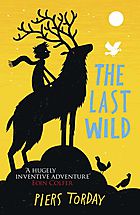
North Melbourne Books: The Last Wild, The Dark Wild and The Wild Beyond follow 12-year-old Kester Jaynes through a series of extraordinary adventures as he tries to save the world from environmental disaster. The novels all have a real cliff-hanger quality to them and segue quite naturally into each other. Did you conceive the story as a trilogy from the beginning? Or did the writing of each novel inspire you onto the next?
Author photo credit: James Betts
Piers Torday: I would love to say I had the whole story planned out to the last detail from the beginning, but it would be a lie! Some writers do exactly that, and I might do for my next series, but these were my first ever books, and I was learning so much as I was going along. What I did begin with was a very clear sense of the world - one without animals, dominated by a single corporate entity, where humankind, other species and the planet itself were locked in a triangulated struggle for survival. I also had some very clear mental pictures of scenes I wanted in the books, from the pigeons rescuing Kester in The Last Wild to the whale singing her song in The Wild Beyond.
But I had no idea that the story leading between all those things would be three books long. I thought initially two at most.
Yet as I wrote, and delved deeper and deeper into this fictional world, and it became more and more “real” to me - the connecting strands just linked up in my head. The idea for The Dark Wild almost arrived fully formed as I was finishing The Last Wild, and The Wild Beyond came to me as I was finishing The Dark Wild. Each book had passages I struggled with - the farm section in the first book, some of the Waste Mountain sections in the second, and the conclusion (not the epilogue) to the third.
What was interesting was that my early drafts of the first book were thousands of words too long, and yet pretty much everything I wrote ended up being used somewhere in the trilogy in some form. Nothing was wasted!
NMB: Kester's adventures, and the many amazing human and animal characters he meets along the way, make for breathtaking storytelling. But there's also a serious side. The novels tackle serious issues such as irresponsible corporate greed, environmental disaster, climate change and species extinction. Have these issues always been serious concerns for you?
PT: I’m very lucky. Not only was I brought up in a very rural, unspoilt corner of the British countryside (a county called Northumberland, just below Scotland), but I was born in 1974 so I still had more wildlife and untouched green open spaces in my childhood than many children today. I’ve always liked animals, from the dogs and cats we had as kids, to the frogs, rabbits, owls, voles, hawks, stoats and so on that we saw in the land around us. At school I was often involved in various eco projects to clean up rivers or do natural history surveys, and one of my favourite books as a child was The Amateur Naturalist by Gerald Durrell (My Family and Other Animals), which is full of wonderful tips for children on everything from collecting specimens to identifying wildflowers.
But am I an expert on nature? No. Am I a dedicated environmentalist vegan who never flies or drives or recharges his iPhone? No. Do I believe all big companies are intrinsically evil, or that the planet has no inbuilt resilience? No.
What I do feel, very strongly, though - and increasingly so - is that the dramatic changes in human development over the last century have consequences which we are only just beginning to comprehend. Over 50% of the world’s wildlife has disappeared since the Second World War, in part due to food consumption, disease spread through air travel and habitat destruction. A human population of over seven billion and rising, with ever widening inequality between a tiny percentage of the global super rich and those without. Multinational companies that have more power and wealth than democratically elected governments. Body, mind and planet changing technologies are developed at an ever quickening rate without due ethical consideration or regulation.
None of these imbalances are irreversible, but neither are they inevitable. I don’t pretend to have the solution to make the world more biodiverse, fairer and more sustainable for all, but I hope that by exciting readers with a thriller that has these issues at its core, it might spark one or two to examine these questions more deeply later in their life. Because it is the generation of children growing up today who will ultimately have to find some answers.
NMB: There's a lot of involved plotting, dialogue (especially seeing Kester is mute and only communicates with animals) and integration of environmental ideas in The Last Wild series. What inspired you to come up with the storylines and characters for the novels?
PT: So many things! Believe it or not, The Last Wild originally began life - a very long time ago- as a sitcom about growing up on a farm. One of the characters was a troubled teen on the autistic spectrum, who found it difficult to communicate. A TV colleague suggested that the script could be improved if the farm animals talked or narrated…and that sparked off the totally different novel idea which became the books. But I kept the idea of a young character who struggled to communicate, and I investigated the phenomenon of selective mutism where children who have experienced trauma can choose to be silent, until therapy has helped them process the emotion. I felt that animals no longer have the “voice” or representation in human life that they once did, and so would perhaps identify with a human who has similarly lost his voice in society. So that’s where Kester came from.
The Stag came about because I wanted the animals in the first book to be British wildlife to excite and remind native young readers here about the world around them. I also wanted a majestic leader of animals, and the lion having been taken elsewhere, the stag seemed a natural alternative. Pigeons were next - they are in cities everywhere, and we treat them like vermin, but these are complex birds with sophisticated navigational skills. Pigeons have played a big part in the human story, from carrying vital messages across No Man’s Land in World War One to helping provide Charles Darwin with the inspiration for his theory of evolution. And cockroaches are pests, yet they too are vital to our ecosystem as nature’s recyclers and waste collectors. I wanted to look at all nature in the round, not just the cute furry animals - although I love those too! The Wolf Cub is a nod to one of the most misunderstood animals in the world, and one of the most used in children’s literature from Aesop to Michelle Paver. I wanted to explore why.
Facto comes from the Latin for factory (Factorium) and formula is inspired by those disgusting looking protein shakes people drink in the gym.
Ideas come from everywhere - the whale in The Wild Beyond is based on a real whale which got trapped in the Thames a few years ago, Dagger is based on a family member’s dog (much nicer than his fictional namesake) and the omnium fruit is based on durian fruit. But for me it comes down to hearing a voice in my head (e.g. the white pigeon) then the character comes from that, and the plot is driven by what they want.
NMB: What kind of feedback do you get from your young readers? Are they inspired to take action themselves to repair the environment?
PT: I get sent many wonderful letters, stories and poems, along with some fantastic fan art, which I love. I think that actually most of the inspiring at this stage is in terms of creative writing, reading and writing books of their own (rather than eco warriors) but as I said above, if just one reader is minded to explore any of the issues raised in the book on a deeper level later in life, then I would rest happy. The books I read as a child have stayed with me more than any others, and it is a huge privilege to write for people at such a formative stage in their lives.
NMB: What books are you enjoying reading at the moment?
PT: I always have several books on the go. At the moment, they range from some Anthony Trollope (because I find reading a classic in bed helps me sleep well!) to some fantastic British YA for a conference panel I am chairing in October (Crow Moon by Anna McKerrow and Seed by Lisa Heathfield). I am also reading lots of books for my new story, out next year. I can’t give too much away, but they include The Sword in the Stone by T H White, Sir Gawain and the Green Knight translated by Simon Armitage and The Usborne Little Book of Castles… Recently I also really enjoyed Wolf Wilder by Katherine Rundell.