Showing posts with label Stanislaw Lem. Show all posts

Tuesday, August 21, 2018

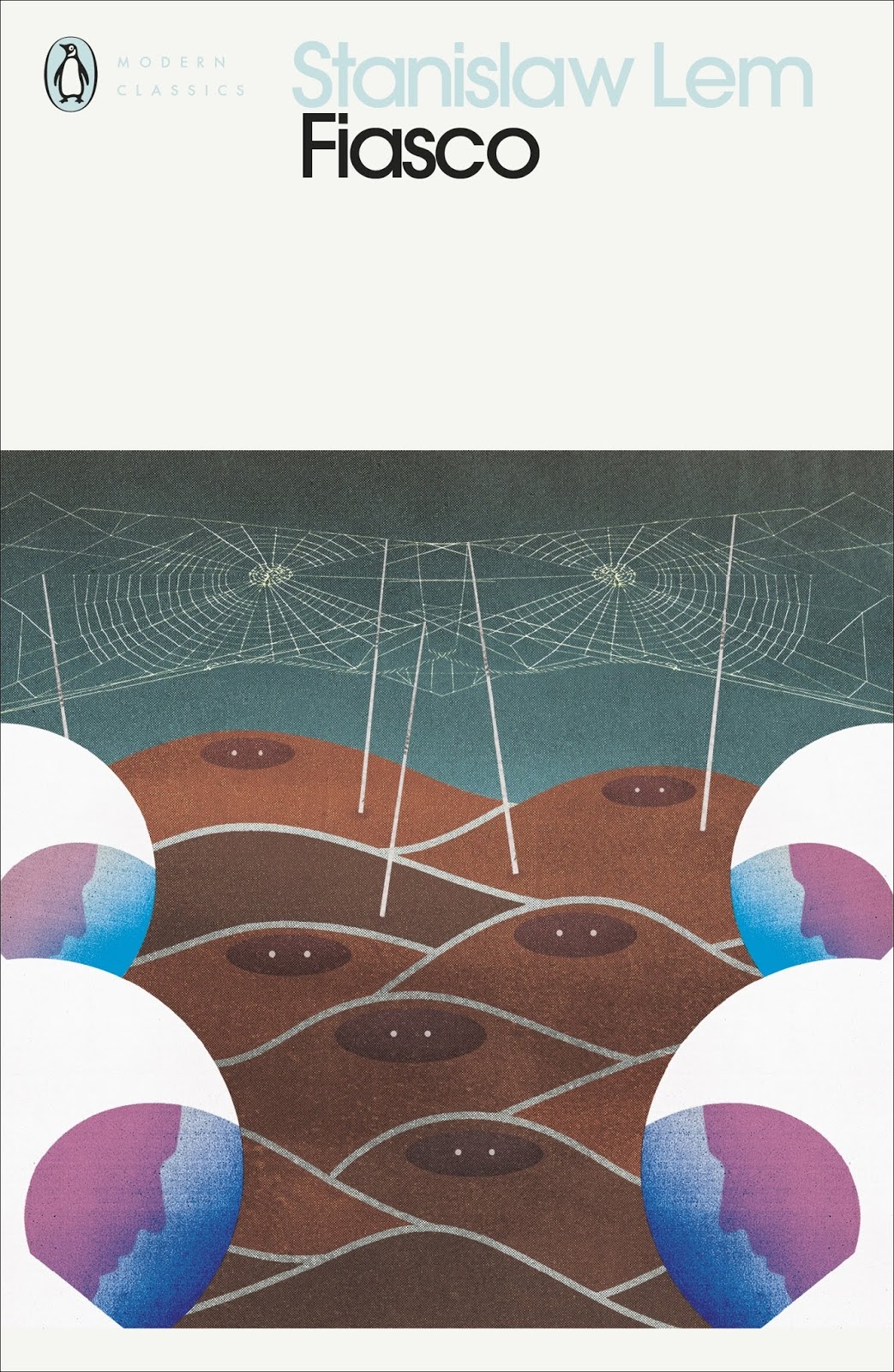
Fiasco, by Stanislaw Lem

Staff review by Chris Saliba

A challenging masterpiece from an indisputable genius.

Fiasco opens describing events that have taken place one hundred years before the main story. A young pilot named Parvis is sent to Saturn’s moon, Titan, to find another pilot, named Pirx, who was lost there. Parvis experiences a fatal accident during the search and before he dies, manages to activate a device that cryogenically freezes him. One hundred years later Parvis and Pirx’s bodies are exhumed. Scientists manage to bring one of the bodies back to life, using organs from the two, but don’t know whether it is Parvis or Pirx. When the reanimated body is brought back to life, it has no memory and goes under the new name of Mark Tempe.

Tempe is asked to take part in a new voyage, to the planet Quinta, which it is believed harbours an intelligent life form on a par with earth’s humans. The huge mothership  Eurydice is dispatched to a black hole near Beta Harpiae, where it sends off a smaller spaceship, the Hermes, which contains a full crew of scientists, astrophysists and even a Dominican priest.

Once the Hermes approaches Quinta, strange, unanticipated things are noticed. The planet is covered with an extremely high volume of radioactivity, a baffling blanket of white noise. The planet is also surrounded by a ring of ice, the result of all the surface water – the oceans - being somehow forced up into the atmosphere. How or why the Quintans have done this is a mystery.

The crew tries to communicate with Quinta, sending out messages over a sustained period, almost like a bombardment. There is no response. More messages requesting contact with the Quintans are sent, but an eerie silence remains. As a show of strength, the crew decides to create a massive cavity on their moon’s surface, but when the missiles are sent they are intercepted by Quinta’s defense system which sends the missiles off course, only to create catastrophic damage as huge chunks of the moon fall to the planet’s surface.

As a final attempt at contact, the crew decides to project a “cartoon” onto Quinta’s clouds. This works, and the Quintans agree to meet a human ambassador. Mark Tempe is sent to the planet’s surface, but when he arrives, and discovers the strange form the Quintans take, he is horrified by their banal, ugly, incomprehensible forms. The whole expedition has been a bizarre – and tragic - waste of time.

Stanislaw Lem’s 1986 novel is an intellectual, philosophical and aesthetic tour de force. It’s a fully realised alien world set in deep space. Like his other first contact novel, Solaris, it is enveloped in a haunting, eerie, claustrophobic atmosphere. The sense of existential dread is palpable. The crew, slowly going insane, are deluded that powerful computers and probability theory can predict life on an unknown planet. Yet all their superior systems continually fail them. The Quintans refuse to communicate. The crew tries to anticipate every possible reason for Quinta’s unfathomable behaviour, but their only response to the maddening silence is the use of violence. In the end this violence turns out to be a show of weakness and impotence.

The basic theme of Fiasco is the limit of human technology and science. Trying to overreach only leads to madness. It could be argued that Lem is saying the human race is a diabolically mad race (Lem was writing in the middle of the Cold War, when nuclear weapons threatened to blow the globe up.) This is a novel that is deeply pessimistic (even cynical) about the kind of hubris that results from too much faith in technology, mathematics and science.

Fiasco is a difficult novel to read and it demands some attention. There are some flaws: the opening chapter, set one hundred years in the past, is perhaps too long; the text can be dense at times, laden with scientific language; and the plot could perhaps move more swiftly. Having said that, Fiasco is a novel that can have few peers for its astonishing range and depth of ideas, written by a man who is an indisputable genius.  

Fiasco, by Stanislaw Lem. Published by Penguin Modern Classics. ISBN: 9780241334355 RRP: $22.99

To sign up for our monthly newsletter, featuring new releases, book reviews and favourite articles from around the web, click here.

Thursday, November 9, 2017

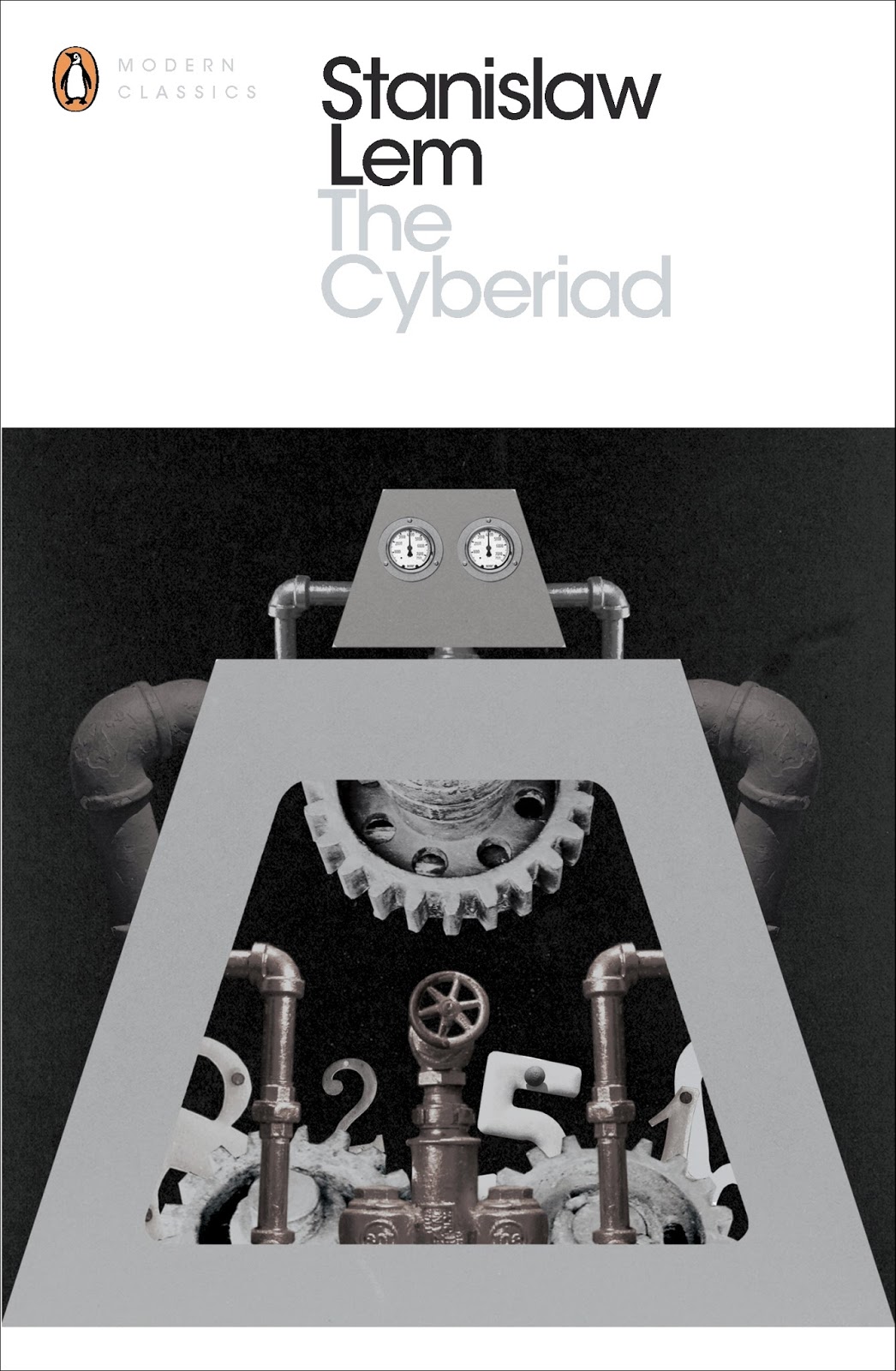
The Cyberiad, by Stanislaw Lem

Staff review by Chris Saliba

A cast of wise cracking robots, electronic bards and storytelling machines discuss philosophy, physics, notions of free will, existence and cyber ethics. Endlessly brilliant, funny and innovative.

Stanislaw Lem’s 1965 book, The Cyberiad, is a work of fiction, but what type is hard to classify. For the most part it is the adventures – both physical and philosophical – of two ‘constructors’, Trurl and Klapaucius. They are builders of robots, smart machines and other electronic devices. The book starts with three stories featuring Trurl and Klapaucius, the middle section is called “The Seven Sallies of Trul and Klapaucius” and a last section of three stories brings The Cyberiad to an end.

The stories all consist of mad plots involving wise cracking robots, electronic bards, storytelling machines, lovesick princes, fussy bureaucrats and tyrant kings (one is named King Kroul, also known as “His Boundless Kroulty”.)  What elevates Lem’s fiction above all the rest is its sheer unbounded and uninhibited inventiveness. His prose, with its endless references to scientific phenomena, dances on the pin of a needle. It doesn’t matter that you don’t know the technical details of the language. In fact, perhaps Lem doesn't know either. He’s inordinately fond of creating so many nonsense words and expressions, his own buoyant vocabulary. Reading Lem you are taken for an exuberant intellectual, speculative and imaginative ride. For example, a computer tries to explain his history:

“A trillion years ago we were a civilization like any other. We believed in the transmittance of souls, the Virgin Matrix, the infallibility of Pi squared, looked upon prayer as regenerative feedback to the Great Programmer, and so on and so forth.”

Or try this wise cracking robot:

“Matrix-schmatrix. Look pal, I’m not just any beast. I’m algorithmic, heuristic and sadistic, fully automatic and autocratic, that means undemocratic, and I’ve got loads of loops and plenty of feedback so none of that back talk or I’ll clap you in irons, that means in the clink with the king, in the brig with the green gig, get me?”

This kind of talk goes on for 300 pages. Lem has his robots and humans constantly bounce ideas off each other, discussing philosophy, physics, notions of free will, existence and cyber ethics. Some of the longer passages read like a sci-fi Socratic dialogue. The Cyberiad is perhaps closest to Gulliver’s Travels in the often perilous journeys Trurl and Klapaucius take to other planets, where they are forced to evade the bad tempers of tyrants and must suffer the endless dead-ends of state bureaucracy. The stories all add up to a kind of existential comedy, an absurdist literature, an intergalactic theatre of ideas by a genuine genius.

Utterly brilliant!

The Cyberiad, by Stanislaw Lem. Published by Penguin. ISBN: 9780141394596 RRP: $24.99

To sign up for our monthly newsletter, featuring new releases, book reviews and favourite articles from around the web, click here.
Saturday, February 11, 2017

Solaris, by Stanislaw Lem

Staff review by Chris Saliba

Stanislaw Lem's Solaris has the well earned reputation of a science fiction classic.

Dr Kris Kelvin is a psychologist sent to a space station hovering above the planet Solaris. The space station is involved in research work, trying to assess life forms on the planet. Two other scientists, Snow and Sartorius, are working on the station when Kelvin arrives. The novel opens dramatically as Kelvin is told by Snow that another scientist on board, Gibarian, has committed suicide. Snow is clearly shaken by what has happened and refuses (or is unable, due to his trauma) to say what happened. Sartorius has withdrawn and is virtually living as a recluse on the space station.

The reason for the fraught psychological state of the space station is the strange apparition of people from the scientists' past. Kelvin soon understands what is going on when is confronted by Rheya, an ex-lover from his past who committed suicide when he left her. She appears real and Kelvin, full of remorse for how their relationship ended, falls in love again with this copy of Rheya that has appeared.

The scientists start to piece together what they think may have happened. The long history of the study of Solaris has shown that the ocean that mostly covers the planet, which is made of a plasmatic kind of jelly, is actually a living being. It has been reading the minds of the scientists and then creating people from their past and placing them on the space station. It's almost a strategy of psychological warfare, but the scientists can't be sure. Their repeated attempts at communication with the ocean have been futile.

Solaris is a perfectly written and imagined short novel, each page maintaining an exquisite suspense. The novel has a genuinely claustrophobic atmosphere that eerily clings. The space station and planet Solaris are so brilliantly drawn that the whole story feel very real. This aspect mixed with the fraught mental states of the scientists (they are all one step away from going mad) makes Solaris utterly compelling. It's the sort of story that is hard to forget once finished.  

Solaris, by Stanislaw Lem. Published by Faber Classics. ISBN:  9780571311576 RRP: $19.99

To sign up for our monthly newsletter, featuring new releases, book reviews and favourite articles from around the web, click here.