Showing posts with label Woody Guthrie. Show all posts

Monday, October 5, 2015

Bound For Glory, by Woody Guthrie

Staff review by Chris Saliba

Woody Guthrie’s colourful memoir is all written in his home dialect. It’s a book full of humour, grittiness and honesty. 

The famous folk singer of the American Dust Bowl, Woody Guthrie, originally wanted to title his freewheeling memoir “Boom Chasers”, after the men chasing money from the oil found in his home town of Okemah, Okla. His wife persuaded him to change it to Bound for Glory, which is just as well, as it is a glorious book.

First published in 1943, Bound for Glory concentrates on Woody’s years growing up, then on his years tramping around the United States as a hideaway passenger on the railroads, and finally on his early years of success as a singer. He notes that fame didn’t bring him much money, even though many presumed otherwise. Along the way there are plenty of colourful descriptions of hobo camps, fist fights, fruit picking, chancers avoiding the rough hand of the law, migratory workers, the injustices of the capitalist system and the tough life of bumming free rides on the trains.

Guthrie’s memoir is notable for its use of the Okemah home dialect. You often see dialogue written this way, but Guthrie has written the entire book in this style. It’s often ungrammatical, with incorrect tenses and misspellings. Using home dialect to tell every word of his story means that Guthrie himself comes across as being somewhat like a fictional character. Bound for Glory could easily be mistaken for a novel. Linguistically, its closest cousin is probably Huckleberry Finn, which is also entirely written in dialect. The miracle of the book is that Guthrie makes it work perfectly, without seeming mannered or artificial. In fact, his language is extraordinarily rich and exciting. A random example gives you the flavour:

“This is where the working people come to try to squeeze a little fun and rest out of a buffalo nickel; these three or four blocks of old wobbling flop houses and buildings. I know you people I see here on the Skid. The hats pulled down over the faces I can’t see, you know my name and you call me a guitar busker, a joint hopper, tip canary, kittybox man.”

The sections of the memoir that deal with migratory workers and fruit pickers searching for work during The Great Depression strongly recalls John Steinbeck’s classic The Grapes of Wrath (1939). The only difference between Steinbeck and Guthrie is the latter’s sense of humour in the midst of great difficulties. There are plenty of funny lines and wisecracks that punctuates the story, whereas The Grapes of Wrath is unremitting in its tragedy and hardship.

For anyone interested in American literature and history, I should say that Bound for Glory is indispensable reading. It has an artistry and a language all of its own. Woody Guthrie  illuminates the hard struggles of America’s underclass with humour, grittiness and honesty.

Bound For Glory, by Woody Guthrie. Published by Penguin Modern Classics. ISBN: 9780141187228  RRP: $34.99

To sign up for our monthly newsletter, featuring new releases, book reviews and favourite articles from around the web, click here.

Wednesday, April 3, 2013

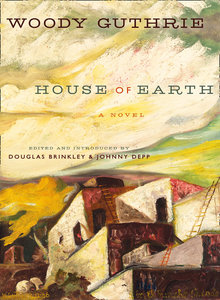
House of Earth, by Woody Guthrie

Staff Review by Chris Saliba

Woody Guthrie's long lost novel, House of Earth, describes the hardships endured in the American Dust Bowl of the 1930s. It is striking for its authentic dialogue and gritty realism, its psychological intensity and raw emotional power.

Woody Guthrie, the famous protest singer-songwriter, wrote songs about the hardships and injustices of the American Dust Bowl. In 1947, he completed his one and only novel, House of Earth. He typed up the manuscript and posted it to filmmaker Irving Lerner, hoping to have it produced. Lerner declined, and the novel languished. When Lerner died and his estate was being sorted out, the typescript came to light. Enter Johnny Depp and Douglas Brinkley. As they were researching a project on Bob Dylan last year, in 2012, they came across the long forgotten novel. House of Earth was published in 2013 under Depp’s imprint Infinitum Nihil.

The blurb on the dust jacked describes House of Earth as a mix between John Steinbeck and D. H. Lawrence, and with this it’s hard to disagree. There is an earthy mix of sex, nature, land and reproduction which is mixed with social realism, politics and the harshness of the depression. The personal and the political are tightly bound in this intensetly intimate tale of a couple struggling against harsh natural conditions and a deeply exploitative economic system.

The novel tells the story of Tike and Ella May Hamlin. They live in a flimsy wooden house that can barely hold against the wind, the rain and of course the dust storms. Tike buys a 5 cent government pamphlet which gives instructions on how to build a house made out of adobe – a solid material made of earth. (In the introduction we learn that this was an idea that would obsess Guthrie in real life.) If the couple could only build a house made of adobe, they would be protected from so much of life’s troubles. A house made out of adobe, earth, represents security and safety.

The couple conceive a child in the first chapter’s long sex scene (you can barely imagine this being published in 1947), or this is when the reader presumes the conception takes place. During this detailed sex scene Guthrie intersperses a lot of dialogue, with Tike and Ella May discussing everything from politics to economics. The last of the four chapters is devoted to an incredibly detailed birth scene.

At heart this novel has a very static feeling, with storms of trouble and nature swirling around the two fragile main characters, trying to make a life for themselves and their new born child. I found myself constantly wondering how they would get on once the novel ended – surely a testament to the authenticity of Guthrie’s characters. Much of TIke and Ella May’s dialogue (not to mention Blanche, the nurse) is so uncanny and idiosyncratic that it’s obviously copied from real life. House of Earth gives an intimate view into the world of those who struggled as farmers and workers in the American Dust Bowl. Not only of their outward circumstances, but also their inner thoughts, hopes and dreams.

House of Earth could have ended up being just another literary curio, but it has real power and resonance. It doubles as a devastating document of the times and a showcase of Guthrie’s artistry, his ear for dialogue and skill at distilling sex, politics and nature into a style that is part stream-of-consciousness, part natural realism.

House of Earth, by Woody Guthrie. Published by Fourth Estate. ISBN: 9780007509850  RRP: $22.99